
NORTH ENGLAND
LITTLE MORETON HALL, CHESHIRE CW12
A stunning example of a timber-framed Tudorbethan moated manor house with rich ornamental panelling.The earliest parts of the house were built for the prosperous Cheshire landowner William Moreton in about 1504–08, and the remainder was constructed in stages by successive generations of the family until about 1610.The last addition, illustrated here, was added by William's son John, who had the south wing built housing a gatehouse with accommodation for guests above and a 68 ft Long Gallery added on top. It is the weight of the Long Gallery that has created the characteristic irregular shape of the building, making the south wing tilt.

Little Moreton Hall, Congleton, Cheshire, CW12
PARK HILL, SHEFFIELD S2
A housing estate that brought "streets in the sky" to Sheffield, designed by Ivor Smith and Jack Lynn Sheffield Corporation City Architect's Department and built between 1957 and 1961, Park Hill was one of the most ambitious inner-city housing projects of its era housing over 3,000 people in 985 flats.
The collapse of the steel industry – Sheffield's biggest income provider and employer – in the 1980s brought the radical ideals of Park Hill to an end. As money ran out, pubs were boarded up and the labyrinth of passages and decks became the perfect place for antisocial behaviour, vandalism and crime.
Threatened with demolition, the fortunes of the complex changed in 1998 when Park Hill was granted a Grade II* listing by English Heritage, making it the largest listed building in Europe. Property developer Urban Splash took over the buildings and commissioned various architects to renovate its dilapidated interiors. Shown here is the final stage of the scheme, a conversion to student housing by Whittam Cox Architects and student housing developer Alumno.
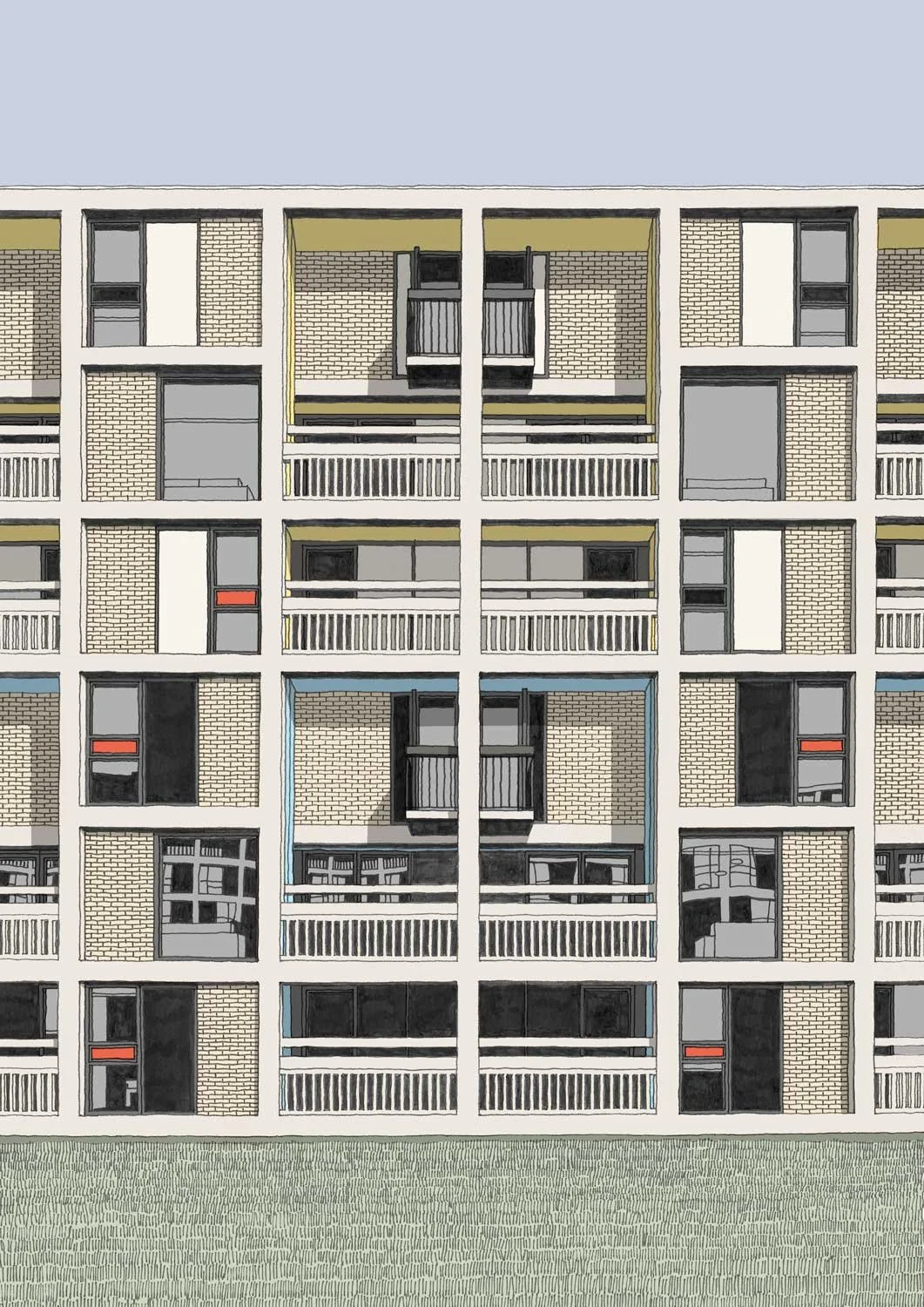
Béton House, Rhodes Street, Park Hill, Sheffield S2 5DT
8 SHAMBLES, YORK YO1
A medieval timber-framed house (now a shop and offices), dating from the early fifteenth century - it forms part of a well preserved medieval shopping street of butchers’ shops and houses with many of the buildings dating back to the late fourteenth and fifteenth century (around 1350-1475). The overhanging timber-framed fronts of the buildings are deliberately close-set so as to give shelter to the ‘wattle and daub’ walls below.
Shambles was mentioned in the Doomsday Book of William the Conqueror in 1086. It was once known as ‘The Great Flesh Shambles’, probably from the Anglo-Saxon Fleshammels (literally 'flesh-shelves'), the word for the shelves that butchers used to display their meat - a prominent feature of the open shop-fronts.

8 Shambles, York YO1 7LY
THEATRE ROYAL, YORK YO1
A 1967 extension by Patrick Gwynne that added foyer and café spaces on two levels to serve the existing theatre building adjacent.
Its glass walls reveal an internal forest of concrete columns whose mushroom profiles produce the impression of pointed arches when seen in perspective, subtly alluding to the late Victorian Gothic brick façade of the actual theatre building.

York Theatre Royal, St Leonard's Place, York YO1 7HD