
VIENNA, AUSTRIA
HAAS HAUS, DISTRICT 1
The Hass Haus is situated on Steph, ansplatz, Vienna’s Innere Stadt (first district). Designed by Hans Hollein, it was controversial from its initiation in 1987 owing to its postmodernist contrast with the adjacent architectural masterpiece - Stephansdom cathedral.
The intrusion of a contemporary glass and stone building was met with a resistance, but if anything, the building’s centrality in Stephansplatz is relatively complementary to the cathedral; the contours of the church are brilliantly mirrored on the Hass Haus’ facade and illustrate that modern architecture can be momentous, as well as unobtrusive to its historical context.
Haas Haus was originally conceptualised as a shopping mall, however it currently functions as a hotel, restaurant and a café and has four floors of retail for an international fashion chain.
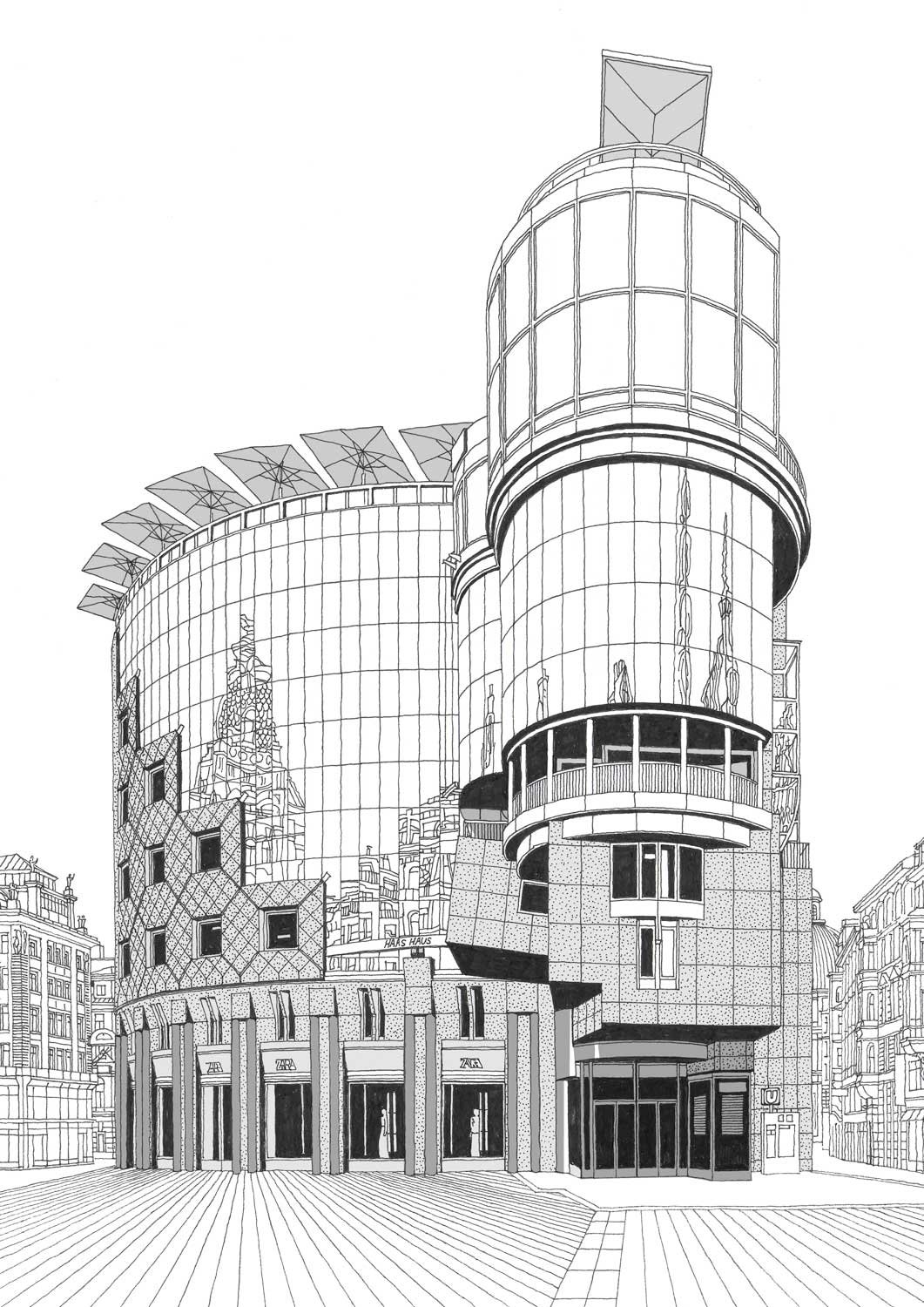
Haas Haus, Stock-im-Eisen-Platz 4, 1010 Wien, Austria
COLLEGIUM HUNGARICUM, DISTRICT 2
The Viennese Collegium Hungaricum (1998) is an institute for culture and science which initiates Austrian, Hungarian and regional cooperation projects, supports young artists, musicians, authors and researchers, and participates annually in more than 80 cultural events in Vienna and Austria.
László Rajk was a leading postmodern architect in Hungary, best known for designing the weird yet wonderful Lehet Market in Budapest. I saw that one last year but didn’t feel inclined to draw it, but Rajk’s building for the Hungarian Institute of Culture, located in Vienna’s Leopoldstadt (District 2) caught my interest. It’s just as weird and eccentric as the Lehet Market, but when the sun is out it comes alive with contorted metal truss shadow play.
Rajk was primarily a set designer, and as such his buildings look as though they belong to the stage, hence the impossibly curving facade distorting the window reveals in bright red, those strange metal truss like objects and the salute to the Hungarian flag are embellished and theatrical.

Collegium Hungaricum, Hollandstraße 4, 1020 Wien, Austria
HUNDERTWASSERHAUS, DISTRICT 3
The Hundertwasserhaus is an attention-grabbing block of public housing in Vienna’s District 3.
The designer, Friedensreich Hundertwasser (1928-2000), belonged to the generation that was disillusioned by modernist architecture and its predictably clean, standardised, sleek shapes (“the straight line is godless,” he said). The Hundertwasser House is none of those things, it is an apartment building according to his ideas for a more human architecture in harmony with nature.
This idiosyncratic building with 52 residential apartments, in brick construction, consists of irregular shapes, harsh but now slightly faded colours, undulating floors, and overblown decorations. The undulating floor in the public areas of the buildings amounts to a rediscovery of human dignity, which was taken away from people in an urban development of flat surfaces.
The grass and forest areas of the house amount to more than 100 per cent of the ground plan - what was taken away from nature by the construction of the building was restored on the roofs. Over the years trees have grown to a considerable size on the roof and project from the apartments. The mosaics on the walls, in the stairways and in the corridors were created by the workers along with the tiles in the kitchens and in the bathrooms, which were laid irregularly to avoid the grid system.
Architects often criticise the building for being kitsch but you should be the judge of that.
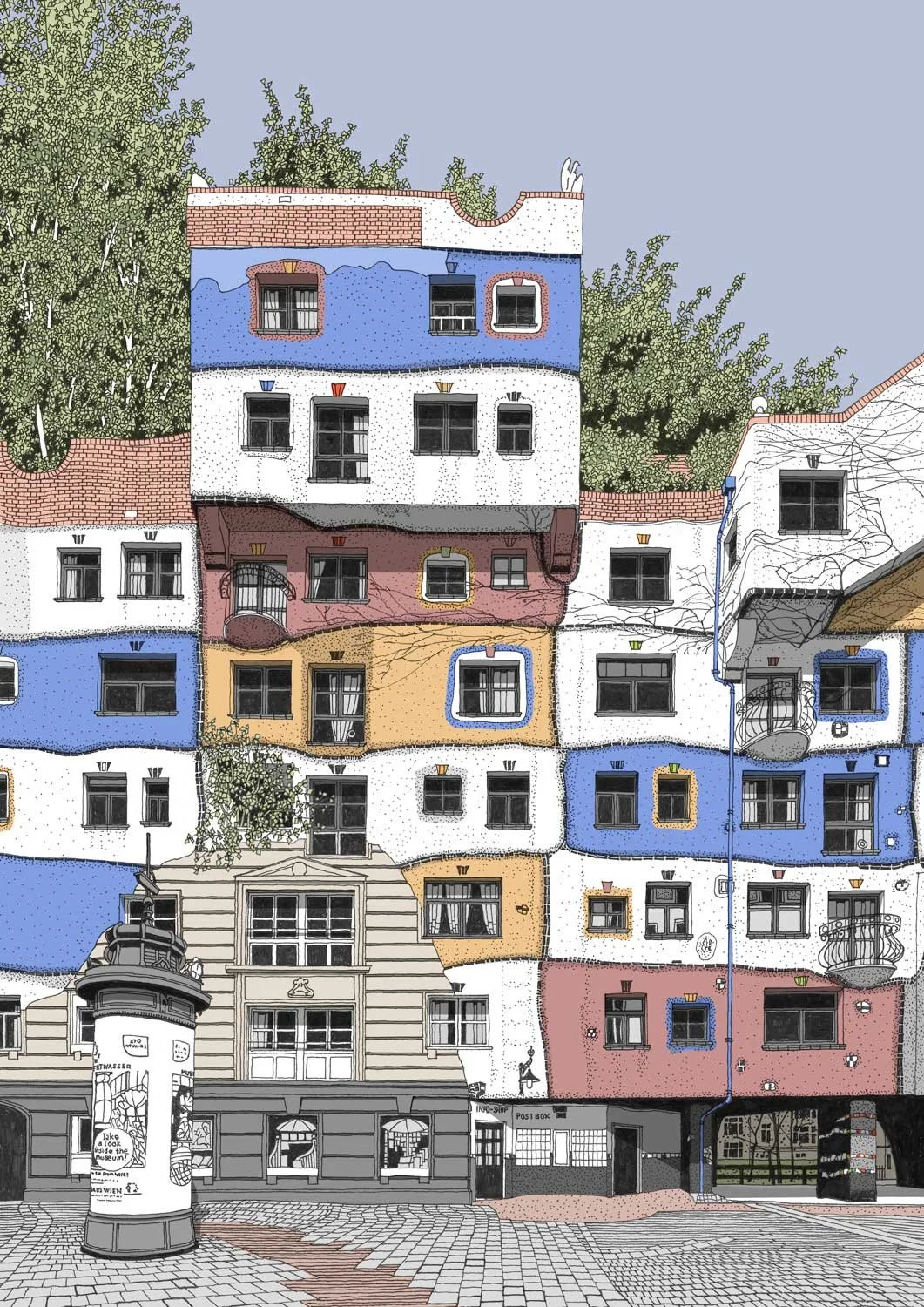
Hundertwasserhaus, Kegelgasse 36-38, 1030 Wien, Austria
SECESSION BUILDING, DISTRICT 6
What’s this severe, windowless, strange white structure topped with a golden "dome" doing in the heart of Vienna? It’s the exhibition hall of the Secessionist artists, the group that struck out on its own in 1897, leaving behind the conservative confines of the nearby Association of Austrian Artists (Künstlerhaus). The building’s construction costs were shouldered by the Jewish industrialist, Karl Wittgenstein, father of the philosopher Ludwig Wittgenstein.
Designed by the most talented of the young bunch, Joseph Maria Olbrich (1867-1908) combined historical motifs such as the Egyptian pylons up top and the Medusa-heads above the entrance with the typical nature ornaments of the Art Nouveau. Laurel wreaths, the sign of victory, project the group’s lofty ambitions while gilded laurel leaves form the symbolic crown of this modern temple of art.
The fourteenth Secession exhibition in 1902 celebrated the life of Ludwig van Beethoven (1770-1827). For this show, Gustav Klimt painted a frieze based on a utopian interpretation of Beethoven’s Ninth Symphony and the power of art. Today, this frieze is exhibited in the below-ground level. The Secession building still functions as an exhibition space for contemporary art and its guiding principle still adheres to the inscription above the entrance coined by the Hungarian art critic, Lajos Hevesi: “To every age its art, to art its freedom."
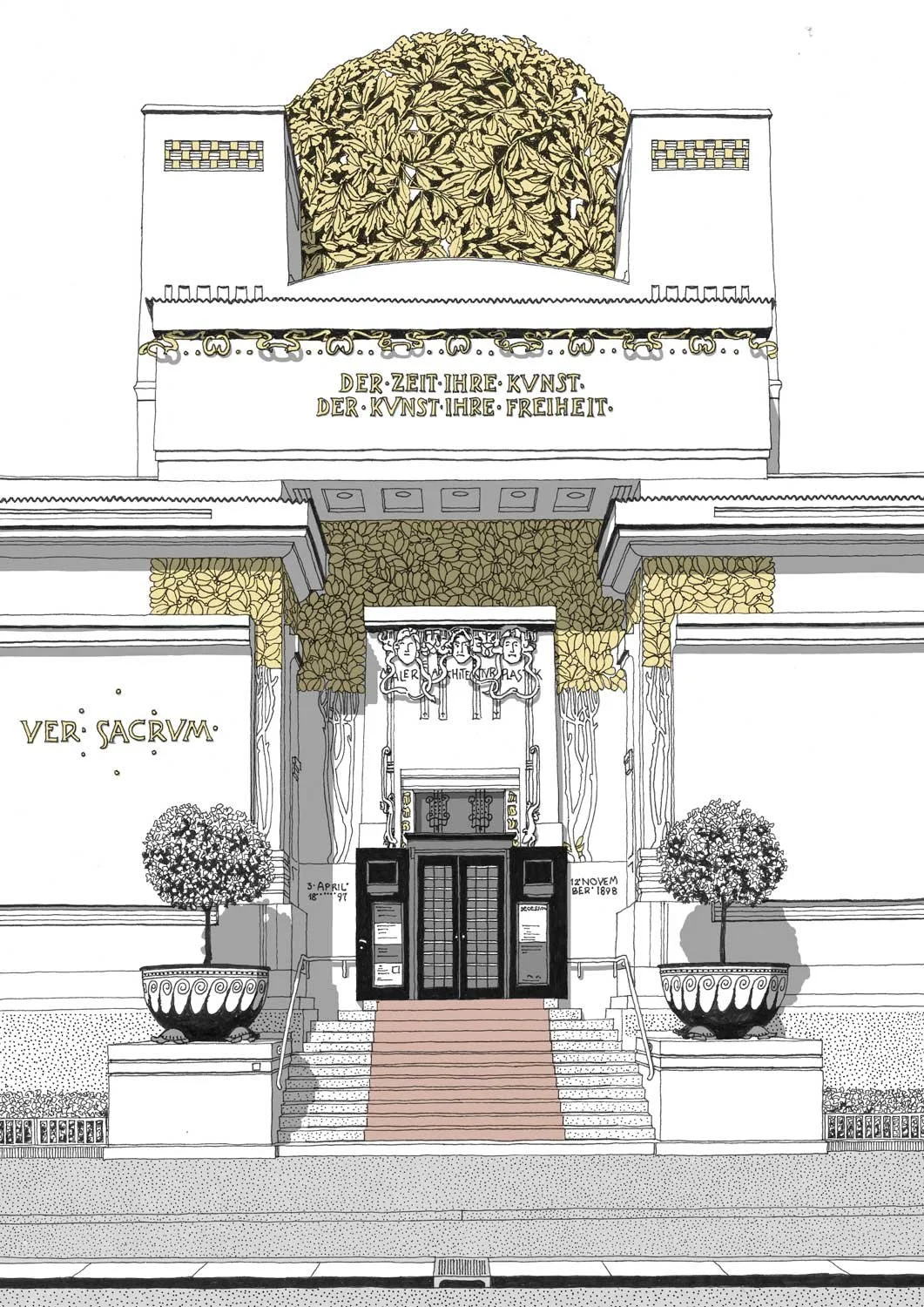
Secession Building, Friedrichstraße 12, 1010 Wien, Austria
KARL MARX HOF, DISTRICT 19
With the 1918 collapse of the Habsburg monarchy and Austria-Hungary, the newly formed Austrian Republic was much reduced in size. Vienna drew tens of thousands of people from territories that fell outside the country’s new borders. This created a critical need for new housing, especially for workers, which the city’s Socialist government – during the “Red Vienna” period of 1918-34 – addressed with huge public housing and infrastructure projects.
Most famous is architect Karl Ehn's monumental Karl-Marx-Hof, a socialist utopian city within the city, complete with 1,400 apartments, kindergartens, communal washing rooms, playgrounds, and green spaces. Repeating red towers with flagpoles project proudly from the facade and soar over this otherwise upper-class neighbourhood in District 19 to the north of the city. By today’s standards the apartments are small, but many come with balconies and the area is lively and well maintained.

Karl Marx Hof, 12.-Februar-Platz 1190, 1190 Wien, Austria
A2/A3 WOHNPARK ALTERLAA, DISTRICT 23
Described as a ‘socialist utopia’, Wohnpark (Residential Park) Alt Erlaa is a giant housing project in Vienna’s 23rd district. Designed by Austrian architect Harry Glück and built between 1975 and 1986, it houses 9,000 people across its 3,200 apartments. Each of the blocks is designed as a series of stacked apartments, organised in the lower part as a series of setback outdoor balconies that turn into covered ones on the upper floor.
Since each unit has an exterior balcony with a large trough planter, residents grow trees, bushes and flowers, giving the buildings their signature green look, which is accentuated by the extensive park designed around and between the blocks. The futuristic look of suspended gardens sets this project apart from Le Corbusier’s towers in the park model for the ‘Radiant City’ from the early 20th century.
While conceived as a project for low-income families, Alt Erlaa offers residents luxurious amenities: there are seven rooftop pools, seven indoor pools, gyms, saunas, and other sports facilities (which are unfortunately closed to the general public). Glück’s concept of ‘a city within a city’ can also be seen in other urban facilities, such as kindergartens, medical clinics, a church, and a commercial centre with supermarkets, restaurants and shops. The complex is easily accessible through a subway station, and the park is entirely public.
It is understandably why Wohnpark Alt Erlaa is often flaunted in the press as an exemplary case of Vienna’s famously good social housing system.
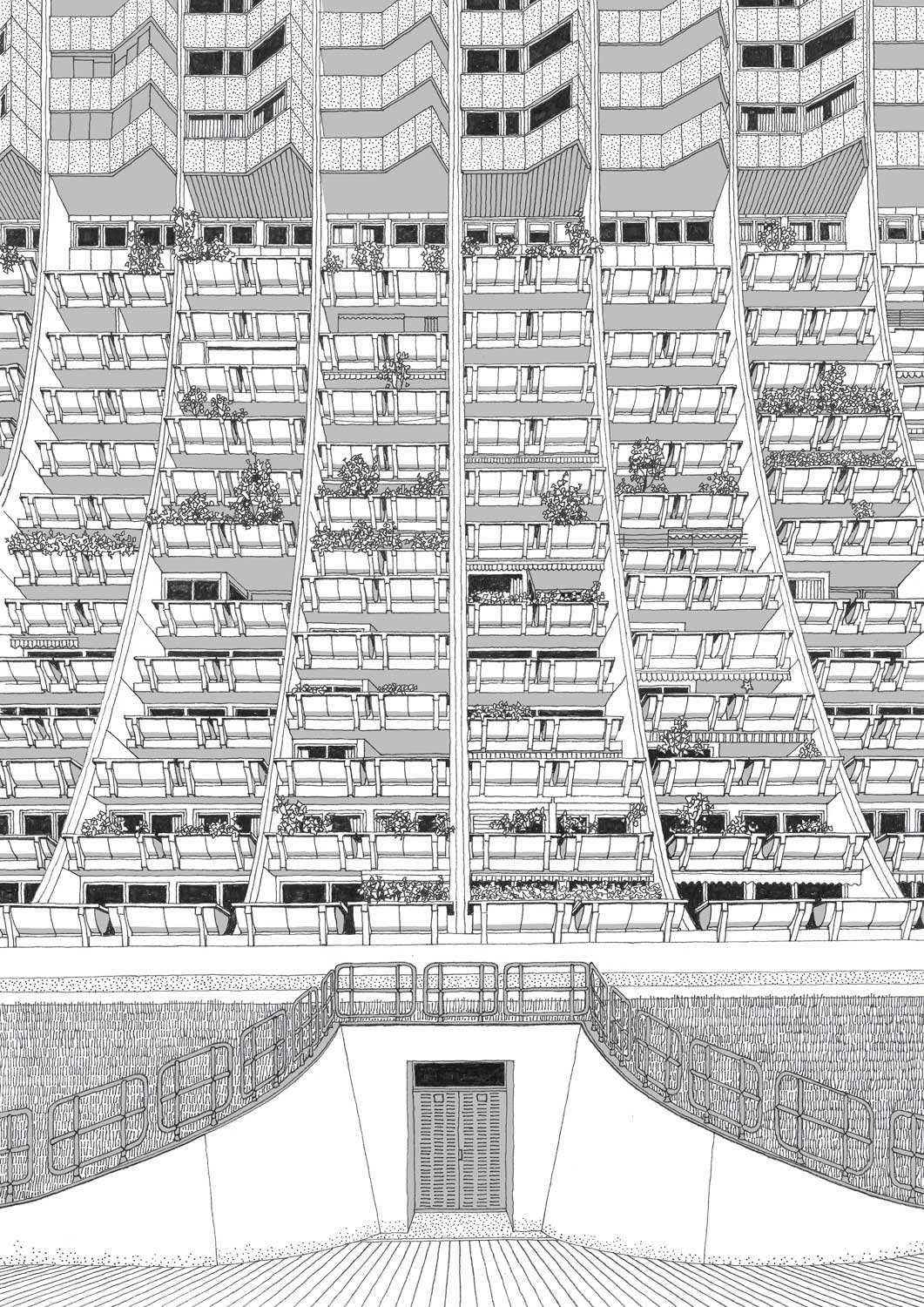
A2/A3 Wohnpark Alterlaa, Anton-Baumgartner-Straße 44, 1230 Wien, Austria