
CITY OF WESTMINSTER
BUCKINGHAM PALACE, SW1A
The royal residence and the administrative headquarters of the monarch of the United Kingdom.
The east wing public façade, illustrated here, includes the front façade and features the famous central balcony. Designed by Edward Blore and built by Thomas Cubitt between1847and 1849, the east wing enclosed the existing three sided palace courtyard.
It was remodelled to its present form during the reign of George V when, in 1913, Aston Webb redesigned Blore's East Front to resemble in part Giacomo Leoni's Lyme Park in Cheshire. The refacing took 13 weeks, undertaken when the Royal Family were on their summer holidays.

Buckingham Palace (I) London SW1A 1AA

Buckingham Palace (II) London SW1A 1AA
ELIZABETH TOWER (II), WESTMINSTER, SW1A
Elizabeth Tower, originally referred to as the Clock Tower, but more popularly known as ‘Big Ben’ was raised as a part of Charles Barry’s design for a new Palace of Westminster, after the old palace was largely destroyed by fire in 1834.
Although Barry was the chief architect of the neo-gothic palace, he turned to Augustus Pugin for the design of the Clock Tower. Construction began in 1843 and was completed in 1859.
The tower is designed in Pugin's Gothic Revival style and is 316 feet (96.3 m) high making it the third tallest clock tower in the UK.
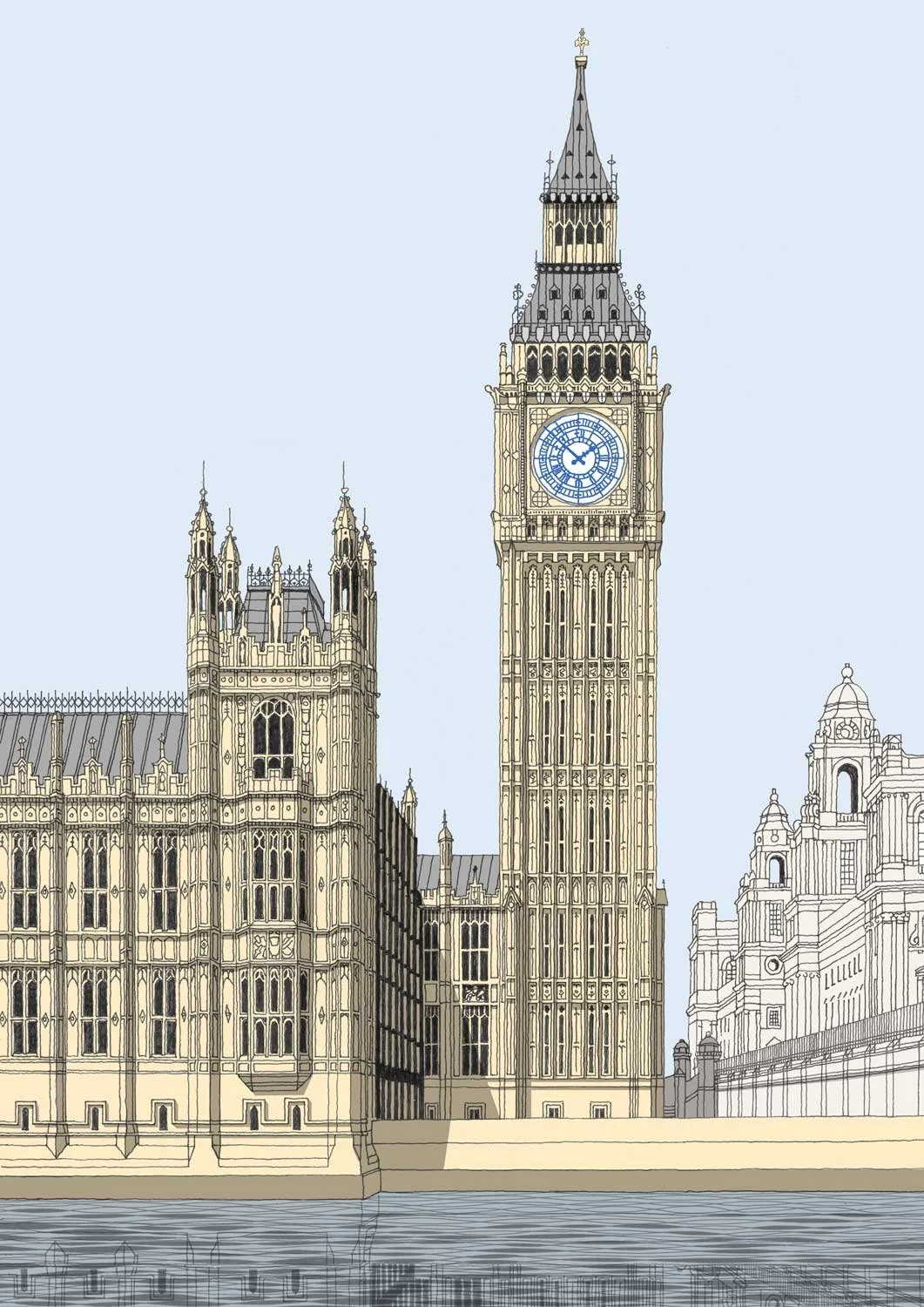
Elizabeth Tower, Palace of Westminster, Westminster, London SW1A 0AA
THE BANQUETING HOUSE, WHITEHALL, SW1A
The Banqueting House, on Whitehall in the City of Westminster, central London, is the grandest and best-known survivor of the lost royal Palace of Whitehall.
Designed by Inigo Jones in a style influenced by Andrea Palladio, the Banqueting House is one of the first examples of the principles of Palladianism being applied to an English building. Begun in 1619 and completed in 1622, it cost £15,618.
The building’s exterior was originally more colourful than today, as it was made with alternating honey-coloured and pinkish-brown stone, with other decorative features in white Portland stone. Today the facade is a monochrome greyish-white, as it was partially refaced with Portland stone in 1774, and then entirely, in a large-scale restoration by John Soane, starting in 1829.

The Banqueting House, Whitehall, London SW1A 2ER
THE NATIONAL LIBERAL CLUB, WHITEHALL, SW1A
The National Liberal Club, situated at 1 Whitehall Place, is a masterpiece of High Victorian Renaissance revival architecture designed by Alfred Waterhouse. Constructed between 1884 and 1887, the building’s exterior is celebrated for its monumental scale and sophisticated integration of late 19th-century structural engineering with historicist aesthetics. Waterhouse utilised a framework of structural ironwork masked by an ornate, highly sculptural façade of Portland stone. The exterior is defined by its dramatic, towering circular angle turret that anchors the corner of Whitehall Place and Whitehall Court, terminating in a conical roof that punctuates the London skyline.
The elevations are meticulously ordered into distinct horizontal registers, featuring deep rustication at the basement level to ground the structure visually. Above this base, the façade erupts into rich architectural showmanship, dominated by tiers of large, stone-mullioned windows, elaborate loggias, and continuous arcading that reflects the internal layout of the club's grand reading and dining rooms. The building features an asymmetrical yet balanced rhythm, incorporating steep gables, ornate dormers, and decorative balustrades that echo the châteaux of the French Renaissance. Waterhouse’s design successfully maximized the prominent, irregular riverside plot, ensuring the club presented an imposing, prestigious face to both the streetscape and the Embankment.

(Commissioned) The National Liberal Club, 1 Whitehall Place, London SW1A 2HE
102 PETTY FRANCE, SW1H
A big, assertive brutalist office block on Petty France in Westminster, overlooking St. James's Park, currently home to the Ministry of Justice.
The heavy massing of the projecting first and second floors presents a striking bunker-like solidity.
Designed by Fitzroy Robinson & Partners, with Sir Basil Spence, and completed in 1976.

102 Petty France, Westminster, London SW1H 9AJ
55 BROADWAY, ST JAME’S PARK, SW1H
55 Broadway was designed by Charles Holden and built between 1927 and 1929 as a new headquarters for the Underground Electric Railways Company of London (UERL), the main forerunner of London Underground. Upon completion, it was the tallest office block in London.
The building, first listed as Grade II in 1970, was upgraded to Grade I in 2011.
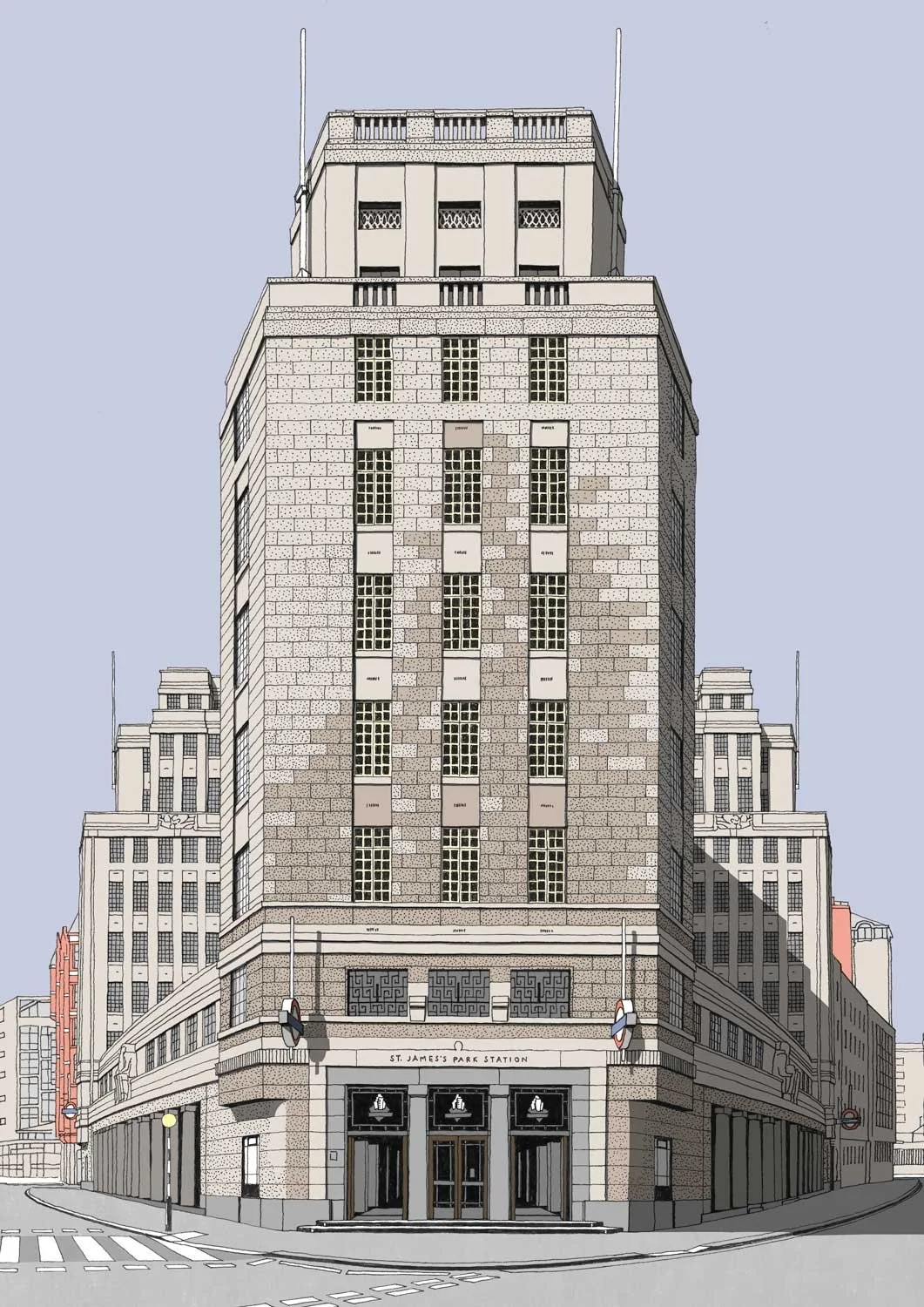
55 Broadway, St Jame’s Park, London SW1H 0BH
NOVA BUILDING, 79 BUCKINGHAM PALACE ROAD, SW1W
A contemporary mixed use building; comprising of residential, office and retail spaces, near to the Victoria rail station and Buckingham Palace.
Designed by Benson + Forsyth and completed in 2017, it’s highly articulated facade features Portland limestone cladding and architectural precast concrete elements.
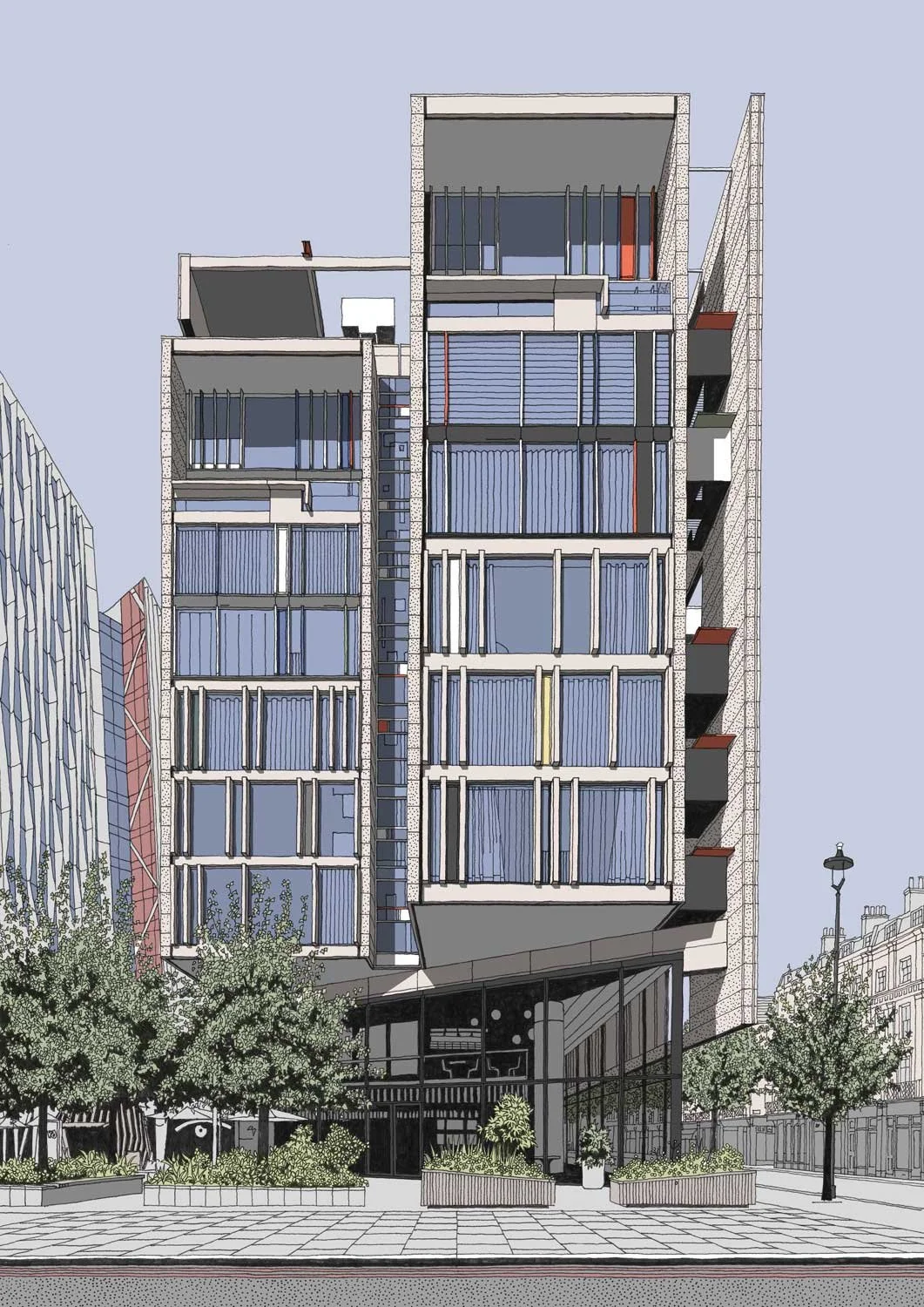
Nova Building, 79 Buckingham Palace Road, London SW1W 0QT
123 VICTORIA STREET, SW1E
A gridded reflective facade of this mixed-use building that lies a short walk away from the major transport hub of Victoria station in central London.
Designed by EPR Architects and constructed between 1973-75, the building features rows of windows that angle outwards to form transparent, box-like forms across the facade..

123 Victoria St, Westminster, London SW1E 6RA
CHANNEL FOUR HEADQUARTERS BUILDING, SW1P
Channel 4’s London headquarters (with the ’Big 4’ ident in front) at 124-126 Horseferry Road, occupies a prominent corner plot near Victoria Station.
Built in 1992-1994 and designed specifically for Channel 4 by the internationally renowned architectural practice Richard Rogers Partnership, 124-126 Horseferry Road is an elegant example of High-tech architecture. This movement emerged in the 1960s and Sir Richard Rogers was a leading advocate.
The building demonstrates many of the movement’s key principles, including the separation of services from the spaces served, the use of prefabricated elements and a technological aesthetic. It was Rogers’ first central London job after the Lloyd’s Building in the City, now Grade I listed.
The two four-storey wings contain office space accommodating up to 600 staff and are arranged in an L-shape, addressing the corner of the street with a curved connecting space framed by two 'satellite towers'. The entrance, through a dramatic concave suspended glazed wall, is the predominant feature of the scheme. A stepped ramp leads from the street over a glass bridge spanning the roof-light of the foyer/cinema complex below.
Channel 4 moved its National Headquarters to Leeds in 2020 but it has retained this building as its London HQ. The award-winning building is one of the youngest listed buildings in England, given listed at Grade II status in 2023.

Channel Four Television, 124-126 Horseferry Road, London, SW1P 2TX
TOTHILL HOUSE, VINCENT STREET, SW1P
The Grade II Listed Grosvenor Housing Estate in Westminster was designed by Sir Edwin Lutyen and built between 1929 and 1935. The estate comprises seven blocks with five of them on Page Street and the remaining two on Vincent Street.
The U-shaped blocks have a ‘Stripped Georgian’ style, faced with grey bricks and white render in a checkerboard pattern.
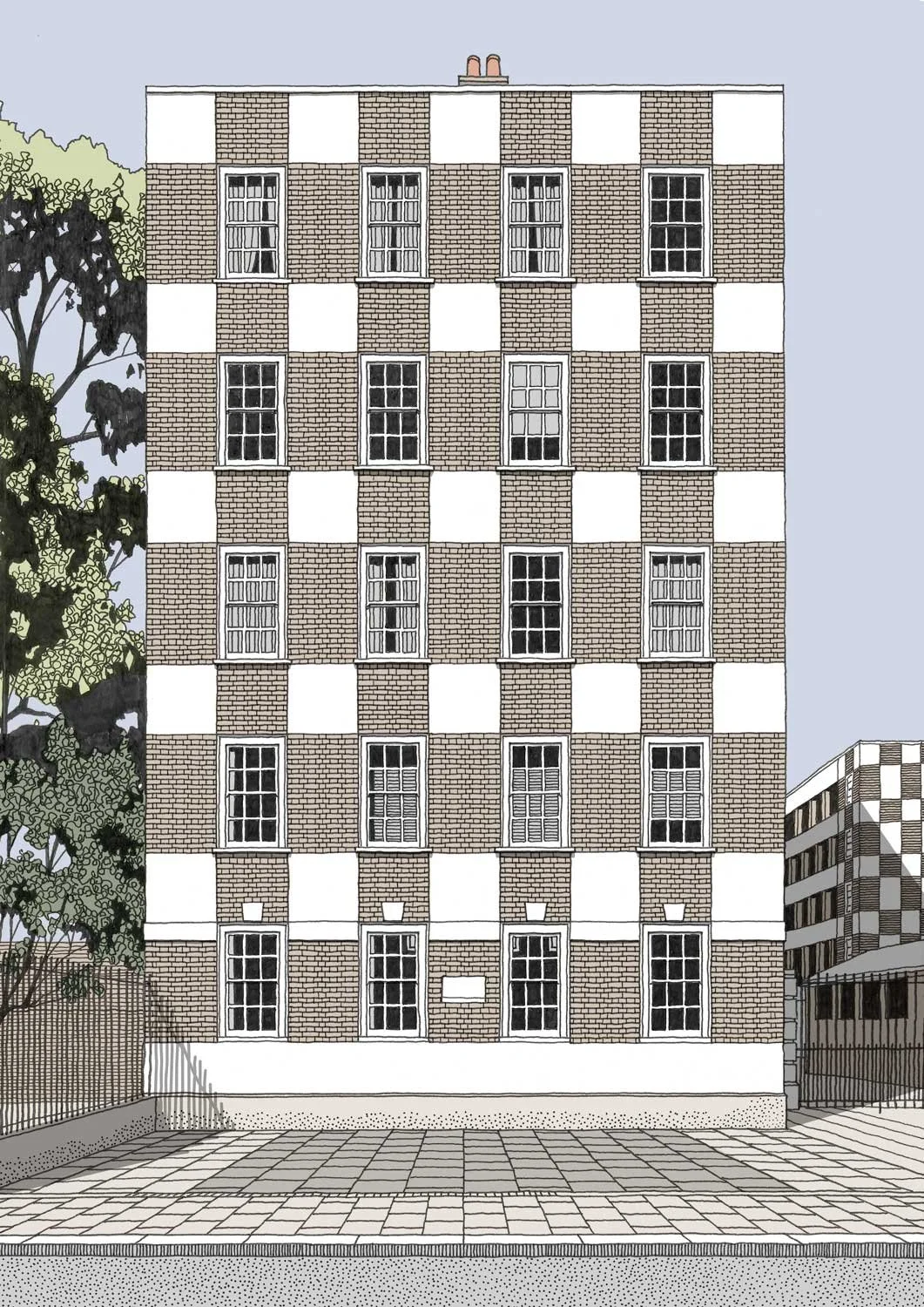
Tothill House, Vincent Street, Westminster, London SW1P 4HL
THE ECONOMIST BUILDING, SW1A
A grouping of three towers of varying heights arranged around a raised public plaza, originally home to The Economist magazine.
Designed by Alison and Peter Smithson and completed in 1964, each building is concrete framed, expressed with bold uprights running from the top of the buildings to meet the floor. The ground level is recessed occasionally and canted at the corners.
The Economist Building’s Portland stone facades, grey colours, splayed corners and projecting ribs demonstrate the traits of the International Style.
The building was granted Grade II listed status in 1988

The Economist Building, 25 St. James's Street, Westminster, London, SW1A 1HJ,
THE MARSHALL BUILDING, LINCOLN'S INN FIELDS, WC2A
Designed by Dublin-based Grafton Architects and completed in January 2022, the Marshall Building stands at the southern corner of Lincoln’s Inn Fields. The façade acts as a modern-day palazzo, dividing its exterior into a grand, three-part plinth of Portland stone and deeply recessed glass.
Following the historic urban grain of the square, the heavy masonry seamlessly transitions into articulated precast concrete fins and staggered setbacks on the upper storeys. These sculptural shifts mediate the building's massive scale against the traditional Bloomsbury Conservation Area, rooting a contemporary academic facility deep into 17th-century London.
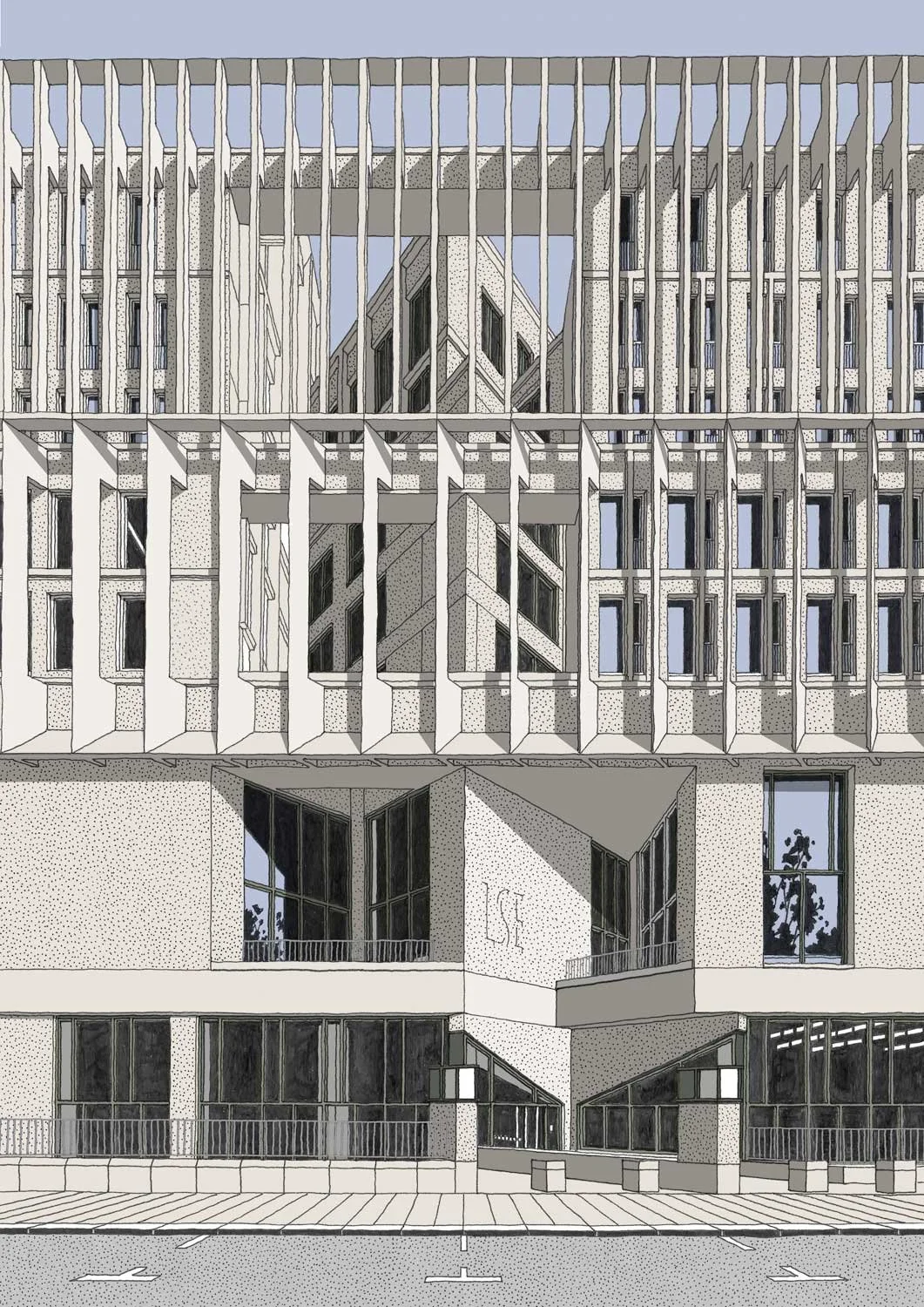
The Marshall Building, London School of Economics, 44 Lincoln's Inn Fields, London WC2A 3LY
SIR ARTHUR LEWIS BUILDING, LINCOLN'S INN FIELDS, WC2A
The Sir Arthur Lewis Building serves as a prominent architectural anchor on the square's southern edge. Originally constructed between 1903 and 1913 to serve as the Her Majesty's Land Registry, the building was designed by the architect Sir Henry Tanner in a striking Edwardian Baroque style. The structure features a grand, symmetrical facade clad in Portland stone and red brick, showcasing heavy rustication on the lower levels, prominent keystones, and a highly decorative cornice. Its classical proportions and monumental scale were intentionally designed to project institutional permanence, authority, and civic importance at the turn of the 20th century.
In the early 2010s, the London School of Economics and Political Science (LSE) acquired the property to expand its urban campus. Following a extensive £36 million student-centric renovation designed by Grimshaw Architects, the building reopened in 2013 and was later renamed in honour of Nobel Prize-winning economist Sir Arthur Lewis. The adaptive reuse project successfully preserved the building's Grade II listed historic exterior while completely modernising the interior. Grimshaw inserted a dramatic, full-height central atrium that floods the inner spaces with natural light, converting the rigid, cellular layout of the old registry offices into open, flexible areas for academic research, postgraduate study, and social interaction.
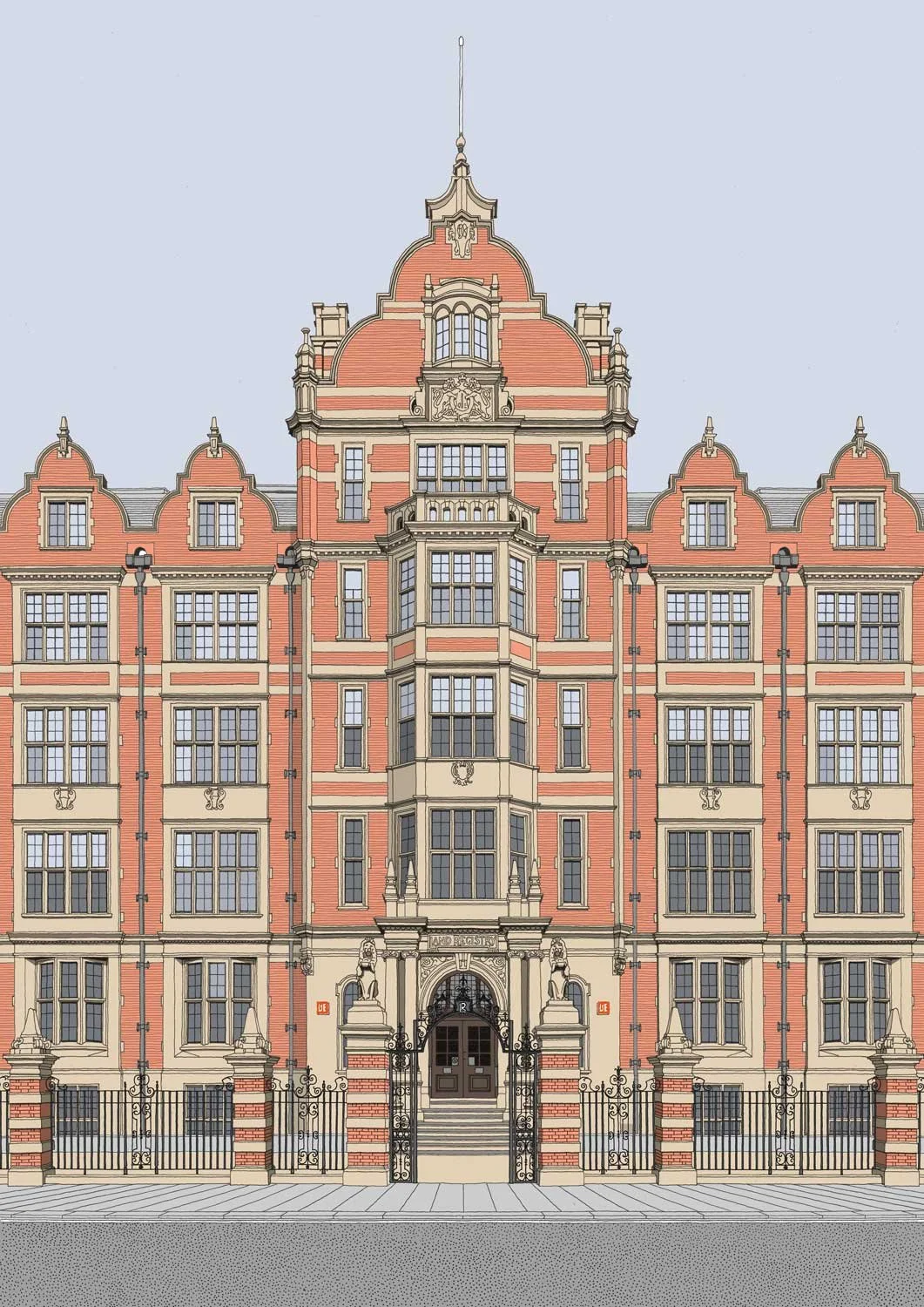
(Commissioned) Sir Arthur Lewis Building, 32 Lincoln's Inn Fields, London WC2A 3PH
CENTREPOINT BRUCE HOUSE FOYER, DRURY LANE, WC2B
Located on Drury Lane in Covent Garden, Bruce House is a substantial mansion block designed by W.E. Riley for the London County Council (LCC) and completed in 1907. Originally functioning as a charitable model lodging house, the property is now owned by the Westminster Council and managed by Peabody, with the ground floor space serving as a hub for the Centrepoint Bruce House Foyer.
Architecturally, the building is a prominent example of Arts and Crafts Free Georgian design. It is defined by a deep-red and brown brick façade, incorporating glazed bricks, a slate roof, and distinctive detailing. The Drury Lane return terminates in a staircase tower and a striking two-storey oriel. The foyer's ground floor exterior retains its historic 1907 character, most notably the semicircular arched entrance ways and large windows.
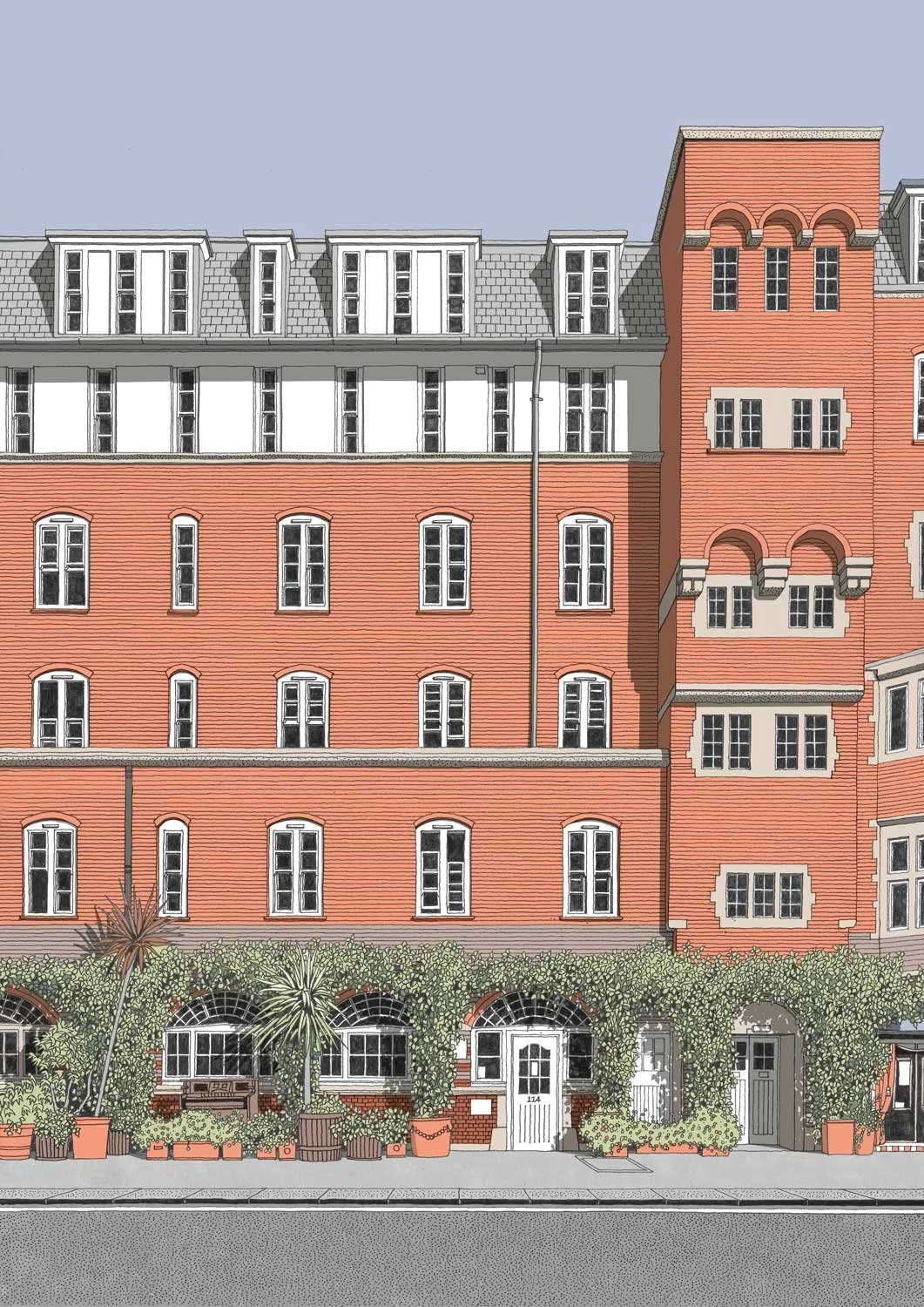
(Commissioned) Centrepoint Bruce House Foyer, 124 Drury Lane, London WC2B 5SU
SOMERSET HOUSE, STRAND, WC2
Somerset House, the single most important public building project of the eighteenth century. An innovative Neoclassical building, London’s first office block and a formidable feat of organisation in bringing together several diverse bodies of scholarship and government. These included the Navy Office, alongside the tax and lottery offices, the Duchy of Lancaster, among other offices and three learned societies: the Royal Academy, the Royal Society and the Society of Antiquarians.
Sir William Chambers received the commission in 1775 and the North Wing fronting the Strand and illustrated here, was the first part of the complex to be built. Its design was based on Inigo Jone’s drawings for the riverfront of the former palace. Borrowing from palace architecture, it has a giant order of pilasters and engaged columns spanning the piano nobile and mezzanine. The windows are marked with pediments or straight heads. By 1780 the North Wing was finished and occupied.
Today, The Courtauld Institute of Art occupies the North Wing.

Somerset House, Strand, London WC2R 1LA
THE MACADAM BUILDING, STRAND, WC2R
An exposed concrete facade to the King’s College London University’s Macadam Building, previously housing the student union now home to the university’s arts, humanities and law faculties.
Designed by architects Troup, Steele & Scott and completed in 1975.
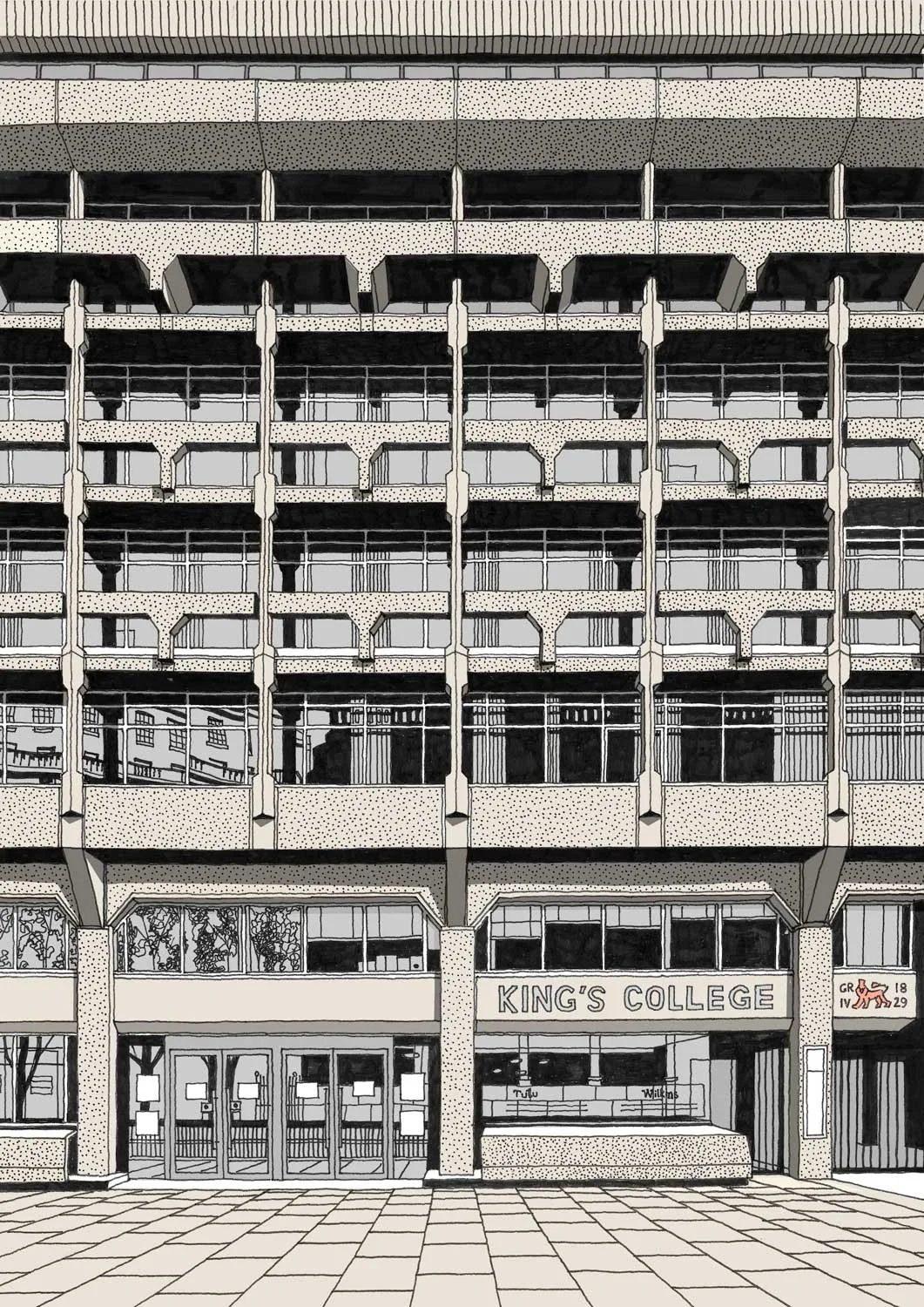
King's College London Strand Campus, Strand, London WC2R 2LS
84 CHARING CROSS ROAD, SOHO, WC2H
Marks & Co. - an antiquarian bookshop which was situated at 84 Charing Cross Road.
The bookshop was made famous by a short novel ‘84 Charing Cross Road’, a memoir composed of letters from the twenty-year correspondence between the author, Helen Hanff and Frank Doel, chief buyer for Marks & Co.
It began in 1949 with an initial inquiry from Helen who was in search of obscure classics and British literature titles that she had been unable to find in her native city. Helene’s ongoing sarcastic and witty letters are responded to by the stodgy and proper Frank and a relationship blossoms into a warm and charming long-distance friendship lasting many years.
The bookshop closed in December 1970 and is now occupied by a fast food outlet.
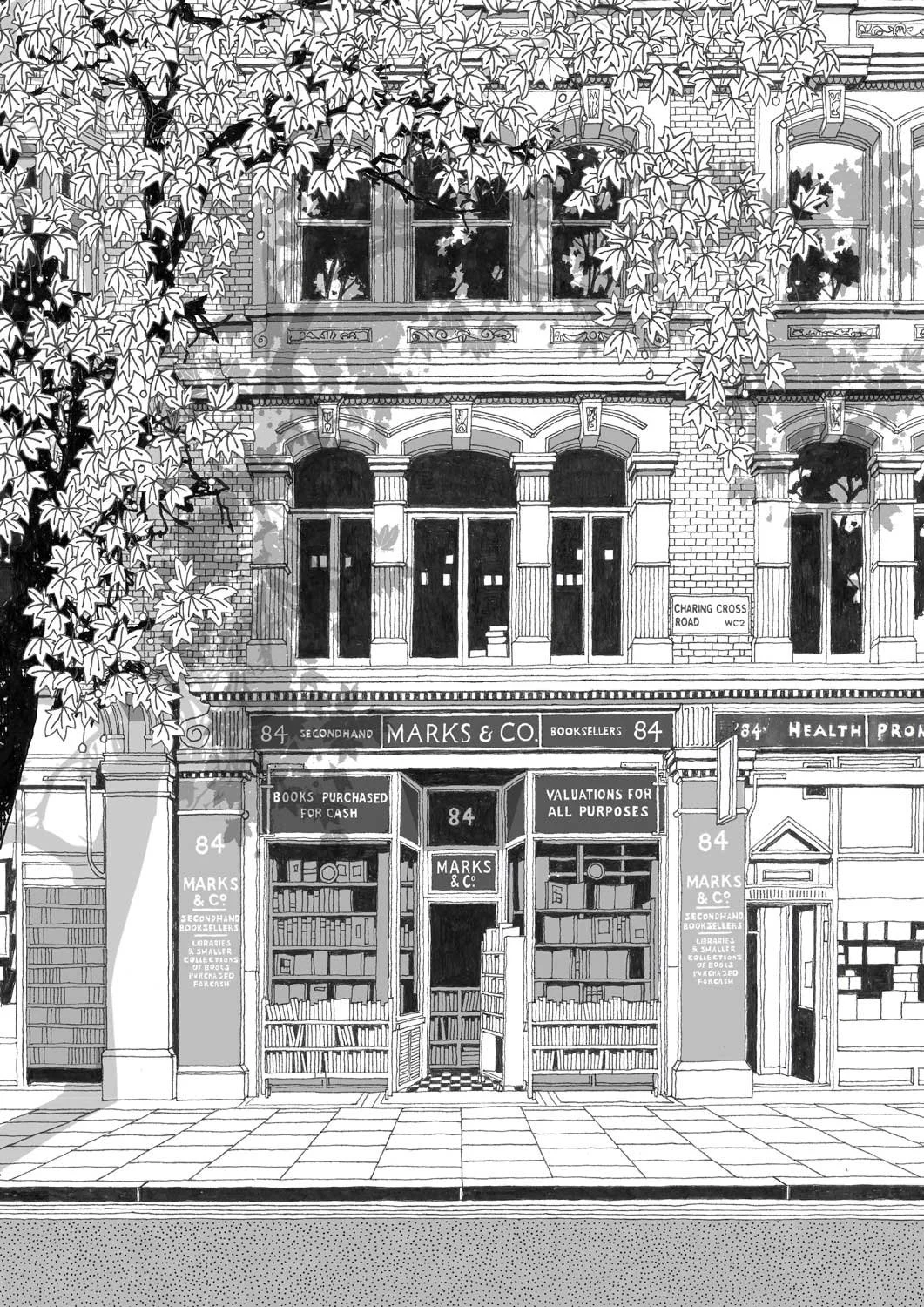
(Commissioned) 84 Charing Cross Road, London WC2H 0DP
SELFRIDGES DEPARTMENT STORE, W1A
Selfridges department store on Oxford Street, designed by American architect Daniel Burnham for Harry Gordon Selfridge and opened in 1909.
Although classical Beaux-Arts in visible style and frontage, the building was an early example in the UK of the use of its steel frame construction.

Selfridges Department Store, 400 Oxford Street, Marylebone, London W1A 1AB
LIBERTY DEPARTMENT STORE, W1B
The Liberty department store was founded by Arthur Lasenby Liberty (1843-1917). Liberty, of Buckinghamshire, England. He worked for Messrs Farmer and Rogers at their store on Regent Street, and was inspired to open his own store after 10 years of working for them.
The current department store was designed by the father and son team Edwin Thomas Hall and Edwin Stanley Hall and built between 1922-1924. Built according to the Arts and Crafts design philosophy of high-quality materials and first-rate artisan skills, the building’s ‘Olde England’- inspired aesthetic echoed Arthur’s admiration for the Tudor period’s traditions of master craftsman guilds, reusing timber from the breaking up of two early19th century “men of war” sailing ships, HMS Hindustan and HMS Impregnable.
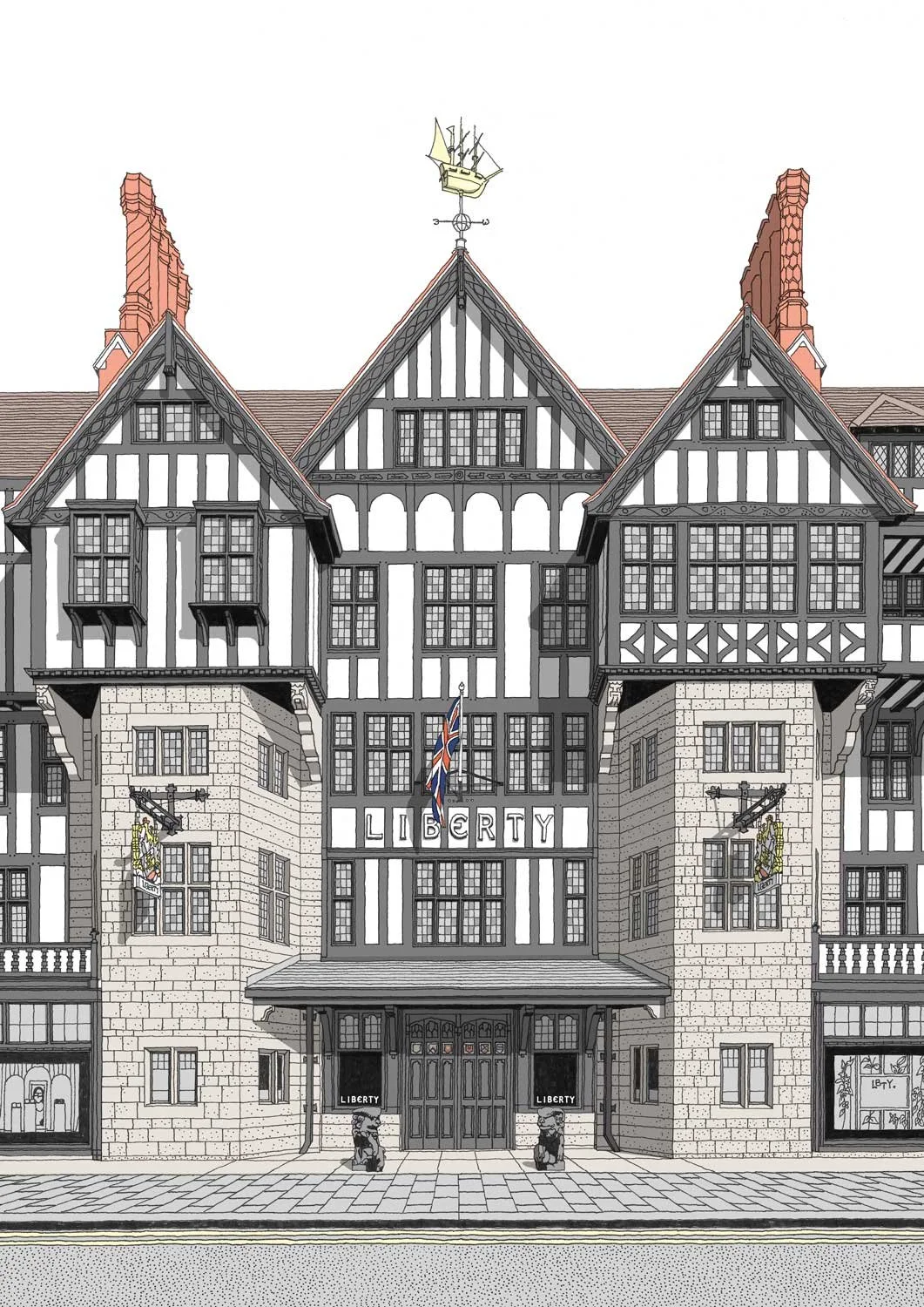
Liberty Department Store, Great Marlborough Street, Soho, London W1B 5AH
ROYAL ACADEMY OF ARTS, PICCADILLY, W1J
The South Front elevation of Burlington House reflects a synthesis of Palladian proportions and Neoclassical remodelling. The core Palladian facade was famously refaced between 1715 and 1722 by the Third Earl of Burlington and his architect, Colen Campbell. They established the commanding arrangement of a rusticated ground floor supporting a piano nobile. This second level is articulated by a rhythmic sequence of seven windows framed by engaged Ionic columns and pediments, directly referencing the architecture of Andrea Palladio and Inigo Jones.
Later transformations in the 19th century profoundly shaped the elevation as it appears today. Between 1815 and 1818, the architect Samuel Ware carried out extensive remodeling and extensions for Lord George Cavendish, culminating in his design record drawings of the south front (c.1816–1820). Subsequently, in the 1860s and 1870s, the elevation underwent major additions when Sydney Smirke raised the central block with a third-storey attic level and added the grand classical portico and flanking wings to house the Royal Academy’s galleries and schools.
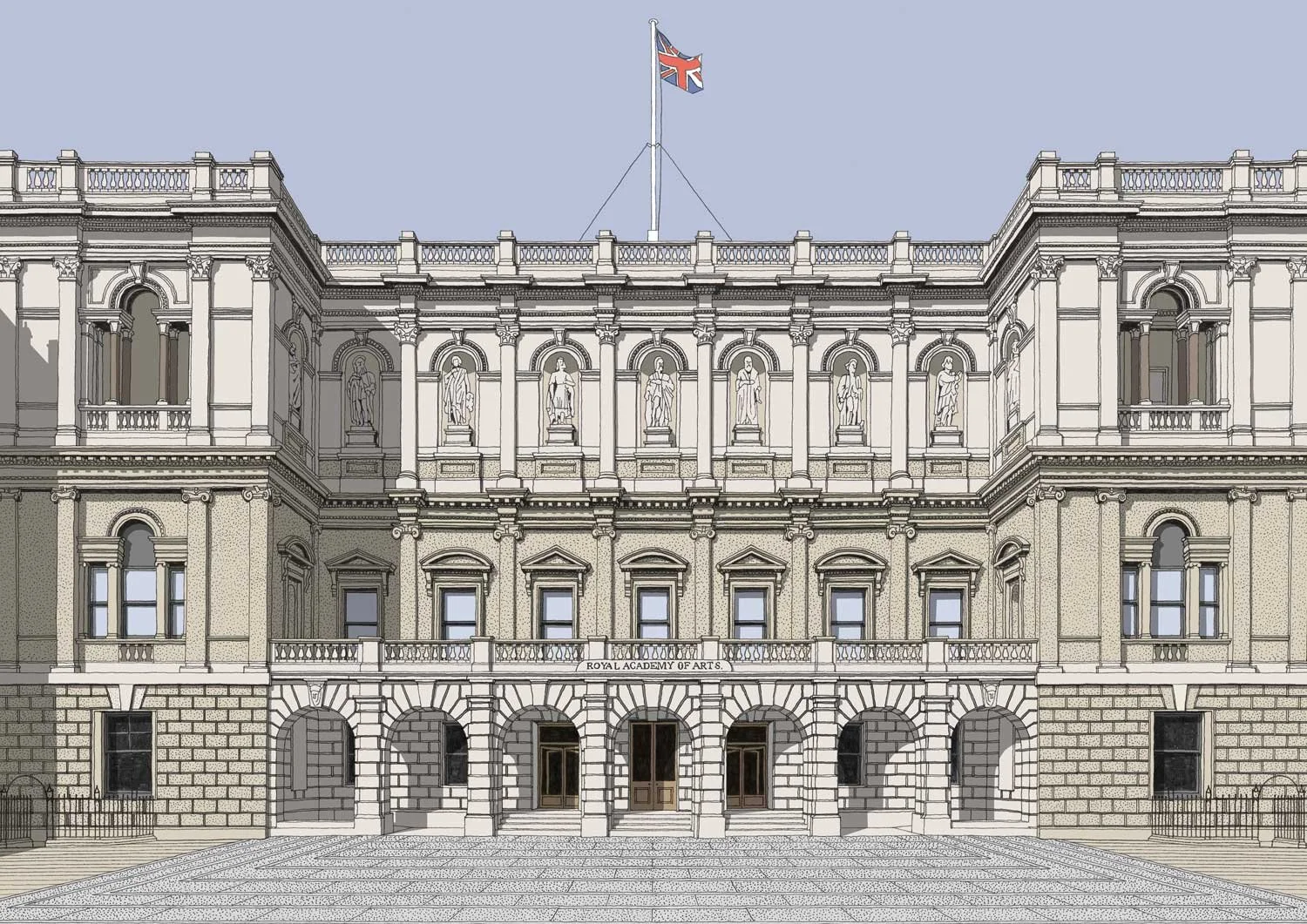
(Commissioned) Royal Academy of Arts, Burlington House, Piccadilly, London W1J 0BD
THE OLD MARYLEBONE TOWN HALL, NW1
The Old Marylebone Town Hall, also known as the Westminster Council House, is a municipal building. The complex includes the council chamber, the Westminster Register Office and an educational facility known as the Sammy Ofer Centre.
The building was designed by Sir Edwin Cooper in the Edwardian Graeco-Roman classicist style and officially opened in 1920.
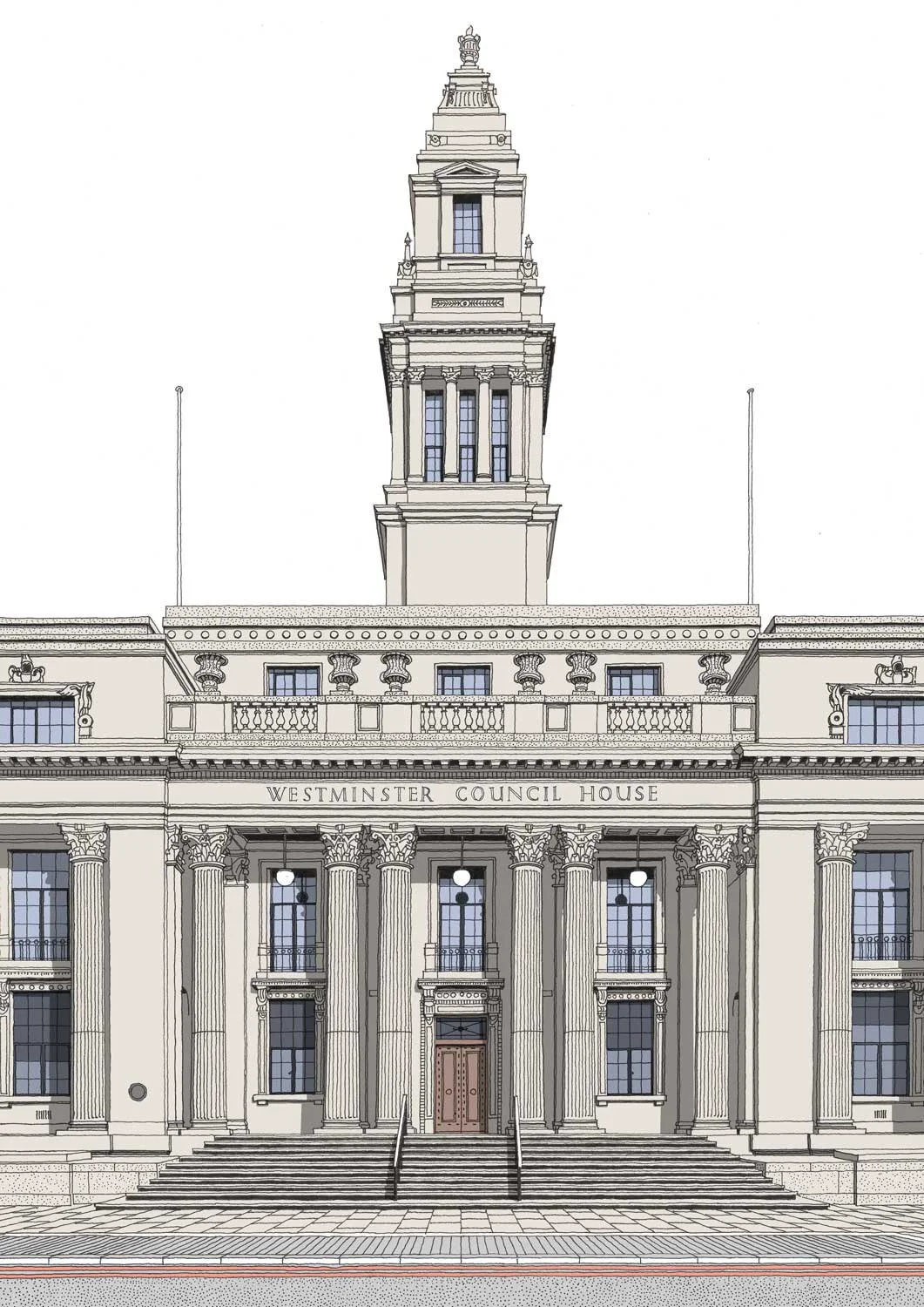
The Old Marylebone Town Hall, 97-113 Marylebone Road, London NW1 5PT
THE LONDON PLANETARIUM, MARYLEBONE, NW1
Located on the site of a former cinema destroyed by bombing in World War II, this was the first large-scale planetarium in Britain, designed by architect George Watt with the engineers Travers Morgan & Partners.
An archetypal 1950’s architecture; futuristic and optimistic for the ‘space age’, it took the form of a tall pre-cast concrete dome clad in copper, resting upon a circular concrete slab approximately 25 metres in diameter; this in turn was carried on a ring of twelve columns, set well back around the circumference of the slab to create a deep canopy.
The planetarium was opened to the public in 1958 and closed in 2006. The building has now been incorporated into the adjoining Madame Tussaud's Wax Museum.
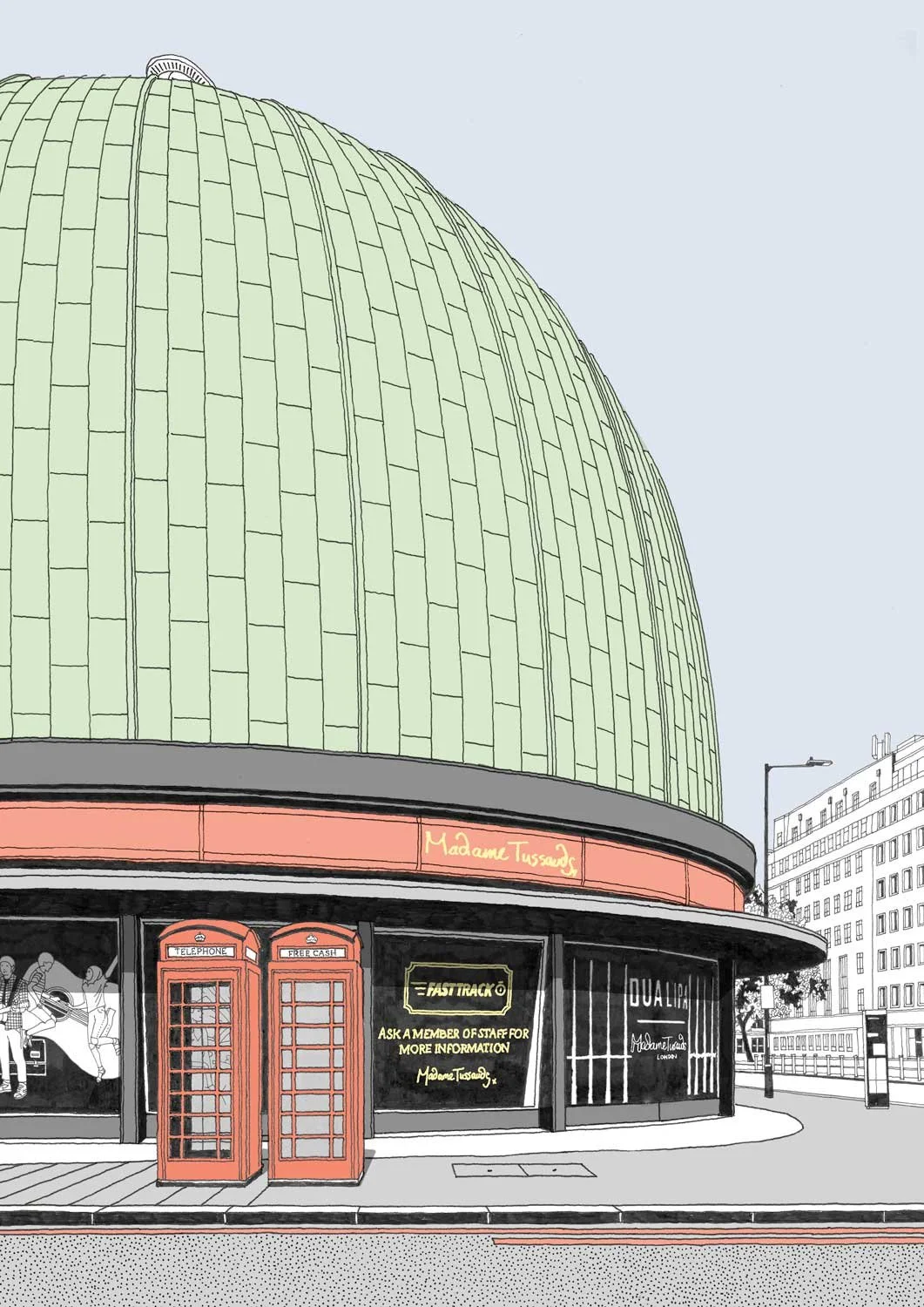
London Planetarium, Marylebone Road, London NW1 5LR
THE BATTLESHIP BUILDING, PADDINGTON, W2
The former British Rail maintenance depot for road vehicles. Designed in 1968 by Paul Hamilton, who had to fit it into a site constrained by the elevated Westway, the Harrow Road and the railways.
Now Grade II listed, it was sensitively converted into offices in 2000 by AHMM.
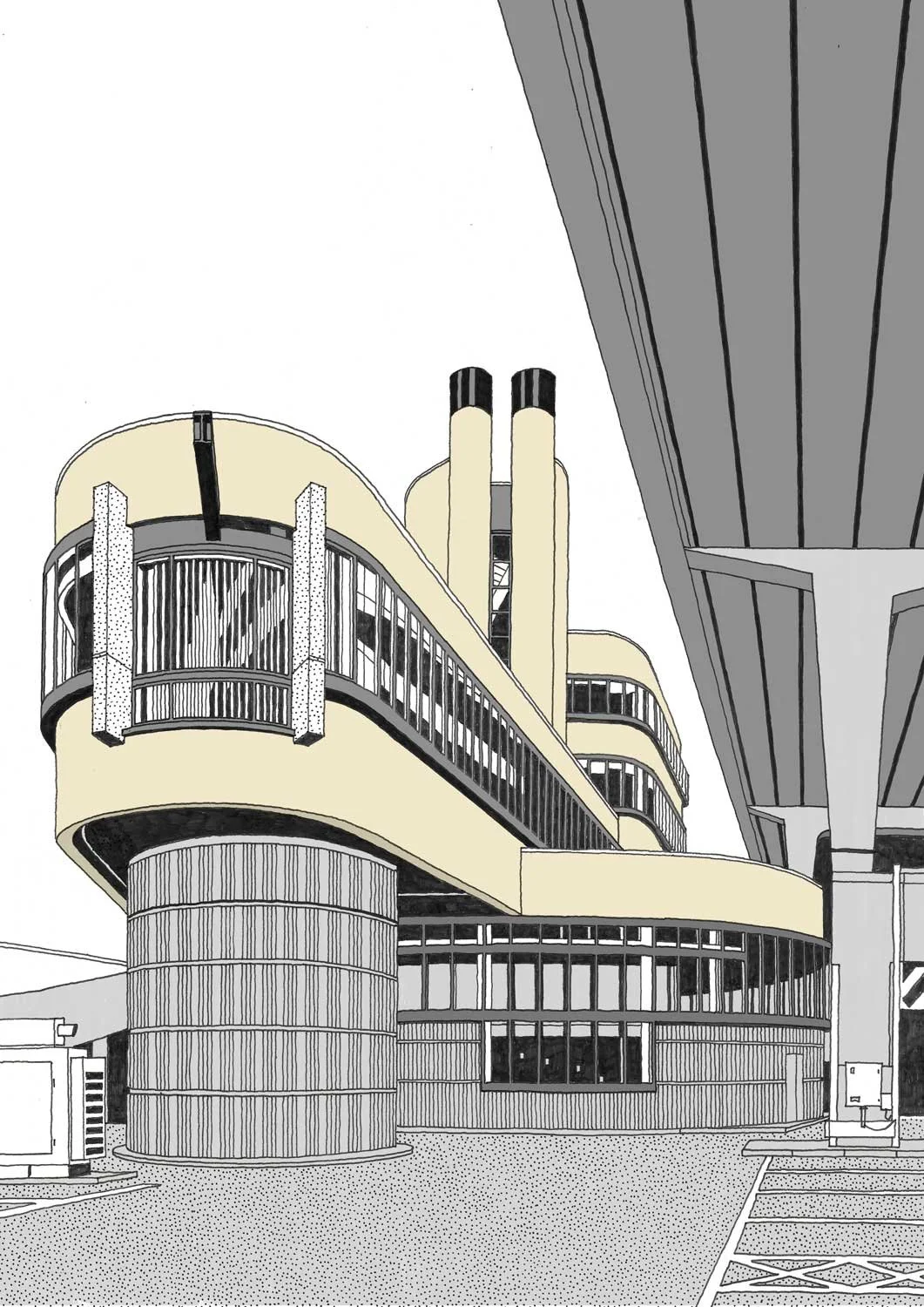
The Battleship Building, 179 Harrow Road, Paddington Basin, London W2 6NB
OSLO COURT, ST JOHN’S WOOD, NW8
Designed between 1937-38 by by Robert Atkinson and now Grade 2 listed. Its a 7 storey, long L-plan International Modern block, planned in depth on a narrow site between Charlbert and Culworth Streets with narrow 2-bay ends to Prince Albert Road and Regent’s Park to the south, as seen here.
The block is built of reinforced concrete and brick infill and cladding with a flat terrace roof. There are Crittal metal casements, bent around the corner on the Prince Albert Road end.

Oslo Court, Charlbert Street, St John’s Wood, London NW8 7EN
VICEROY COURT, ST JOHN’S WOOD, NW8
Viceroy Court overlooks views of Regents Park and the London skyline beyond. Containing 84 luxury flats, it was built between in 1934–36 to designs by the architectural firm Marshall and Tweedy.
The semi-circular windows on the end of the building forms a cantilevered alcove in each main living rooms above the ground floor.

Viceroy Court, 58-74 Prince Albert Road, St. John's Wood, London, NW8 7PR
LAWRENCE HOUSE, MILLBANK, SW1P
Lawrence House forms part of the Millbank Estate - a humane, Arts and Crafts socialist housing design that was inspired by Webb, Lethaby and Smith and Brewer with "Queen Anne" and Northern European features.
Designed by architect R Minton Taylor and built between 1897 and 1902. Now Grade II listed

(Commissioned) Lawrence House, Millbank Estate, Westminster, London SW1P
ST GEORGE’S SQUARE, PIMLICO, SW1V
Pimlico is known for its garden squares, grid of streets and stuccoed terraces - all laid out by Cubitt and which was begun on 1825.
Seen here are two of Cubbit’s five storey stuccoed terraced houses on St George’s Square The square was originally laid out in 1839 by Cubitt as two parallel streets, but by 1843 had been developed into a formal garden square lined on two long sides and two sides of an angle in the north. It was London’s first residential ‘square’ that opens to the River Thames.
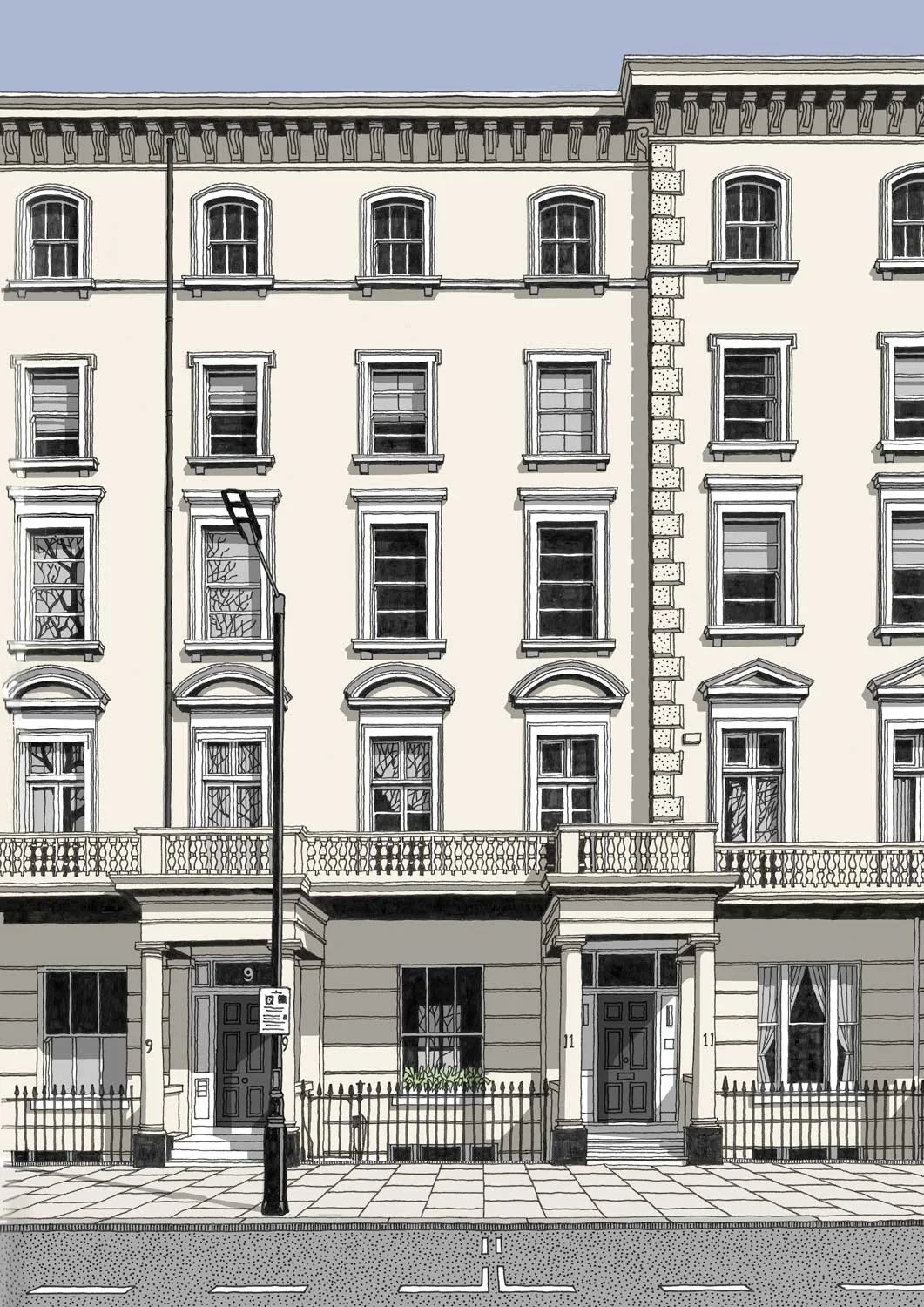
St.George’s Square, Pimlico SW1V
CAMBRIDGE STREET, PIMLICO, SW1V
The grander Pimlico terrace to the right of this illustration is typical of the area. At four stories it shows a full range of classical details; a columned portico, rusticated stucco to the ground floor, bottle balustrades, pedimented windows to the first floor, and dentil cornice to the parapet, behind which the roof structure is largely hidden.
On this street of predominantly stucco houses also sits no. 76-78 Cambridge Street, designed in 1969 by architects Peter Foggo & David Thomas, who shared a passion for the work of Mies van der Rohe. It is a small infill site comprising of two maisonettes framed by an external concrete grid with a smoked glass infill (reflecting the buildings opposite).

76-78 Cambridge Street, Pimlico SW1V
CHURCHILL GARDENS, PIMLICO, SW1V
Churchill Gardens was a pioneering development completed under the ambitious Abercrombie Plan to redevelop the capital more efficient lines with its Le Corbusier-inspired blocks marching across the landscape by the river. It was built between 1946-1962 by the architects Powell & Moya and is now a conservation area.

Chaucer House, Churchill Gardens Road, Pimlico, London SW1V 3DW
LILLINGTON GARDENS, PIMLICO, SW1V
Constructed in phases between 1961 and 1980 to a plan by Darbourne & Darke, Lillington Gardens stretches the considerable length of Vauxhall Bridge Road and is perhaps the last of the high-density public housing schemes built in London during the post-war period.
Unlike the rational post second world war town planning of slab blocks set in landscaped open spaces at Churchill Gardens, Lillington Gardens Estate in contrast attempts to reintroduce human scale, variety, natural materials and urban spaces. The design uses brick and multiplies it into advancing and receding balconies, whilst a myriad of intriguingly interlocking flat and maisonette plans are set along ‘roof streets’ with planted gardens.
The estate was designated as a conservation area in 1990.
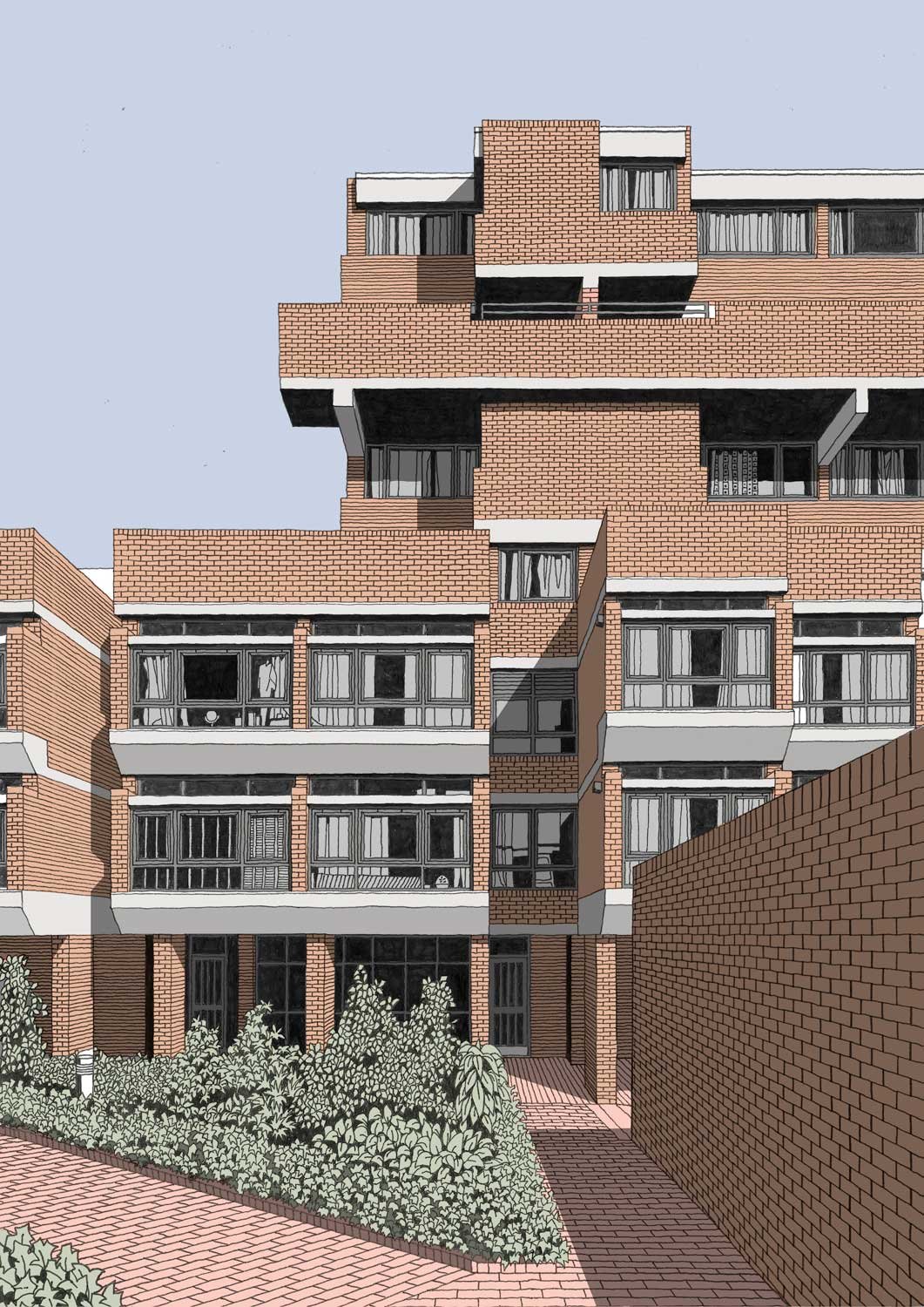
Morgan House at Lillington Gardens, Pimlico, London SW1V
STACK HOUSE, BELGRAVIA, SW1W
Built between 1950-52, this striking example of a postwar apartment block was designed as one of four in a landscaped setting by T.P. Bennett.
Designed in a moderne style, it demonstrates a hybrid of architectural characteristics. The contextual detailing of upright red brick elevations with mock Georgian sash windows are softened by thirties inspired long rounded balconies and large coloured cylindrical columns typical of the fifties.
The Cundy Street Estate was issued with a Certificate of Immunity in 2018 and have since been demolished for estate redevelopment.

Stack House, Cundy Street, Belgravia, London SW1W 9JS
PEABODY COLESHILL FLATS, BELGRAVIA, SW1W
A block of artisans' dwellings built by the Peabody Trust in 1871- an enlightened landlord who wanted to provide decent accommodation for the working classes.
Peabody flats are often built in pale brick and sometimes with access balconies like these. On the ground floor are shops, and between the pairs of shops are entrances that lead to stairs to the balconies above. They are often very plain, basic buildings, but this example has a very decorative French-style pavilion roof, topped with ornate iron cresting.

Peabody - Coleshill flats, Ebury Street, London SW1W 8UT