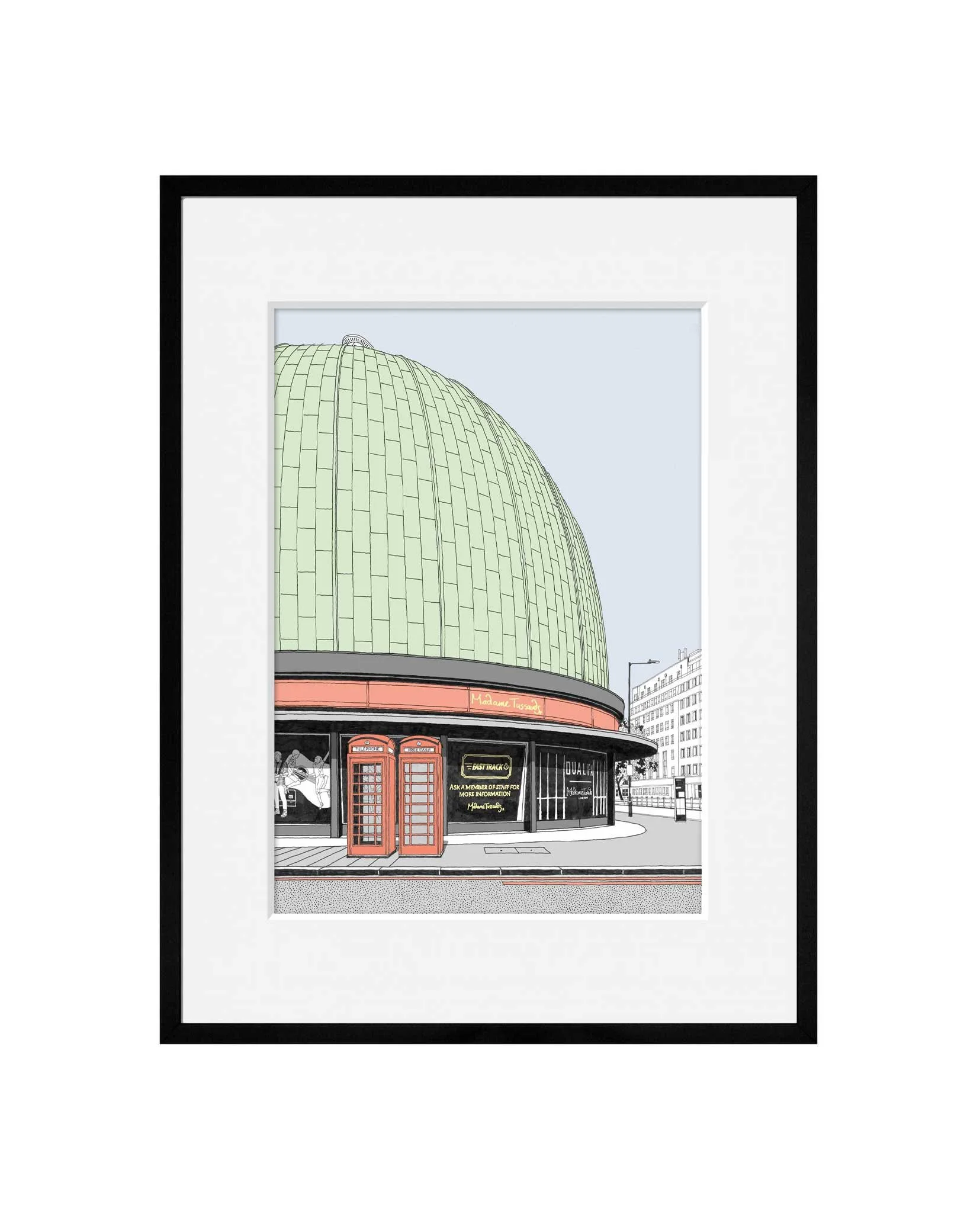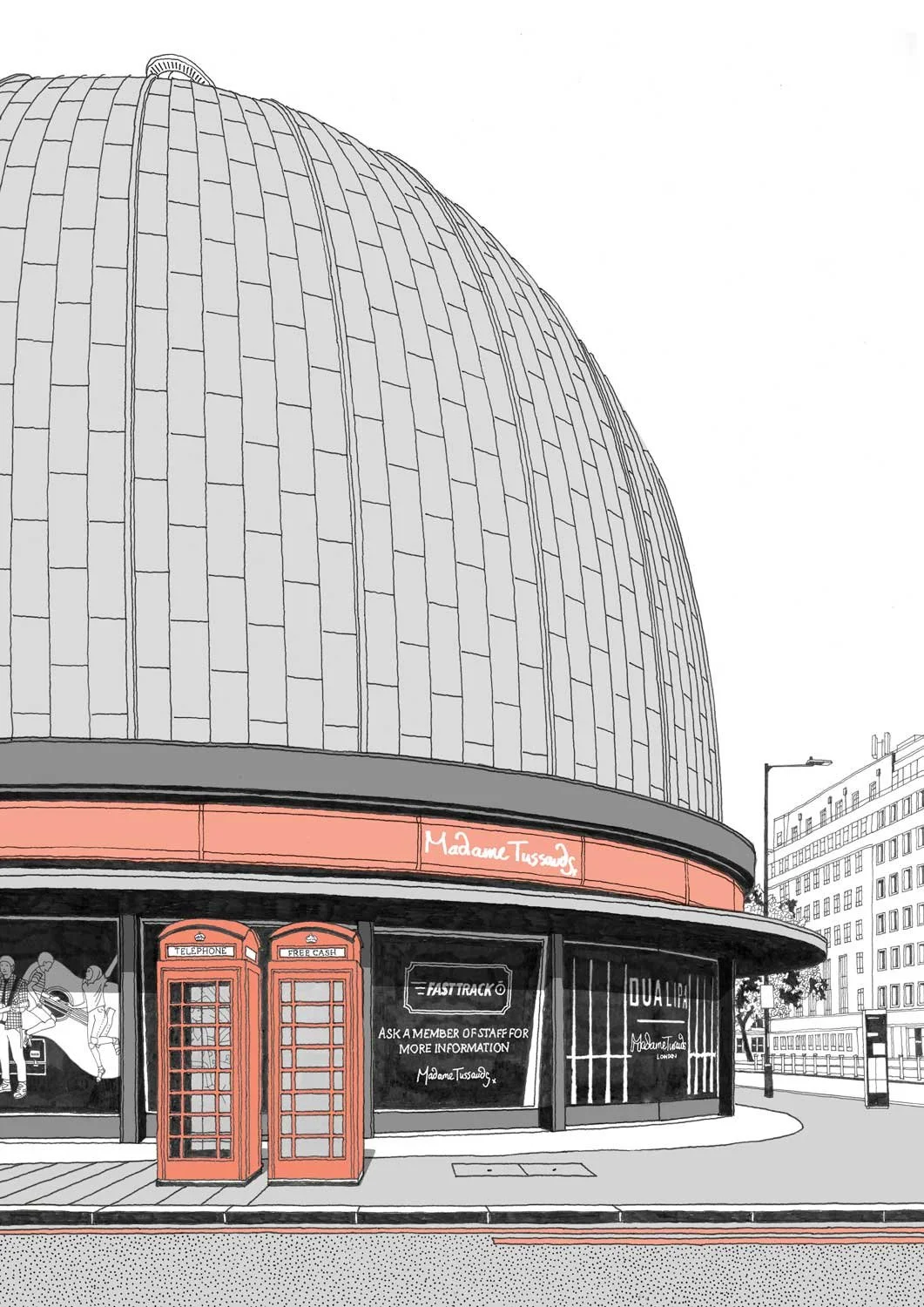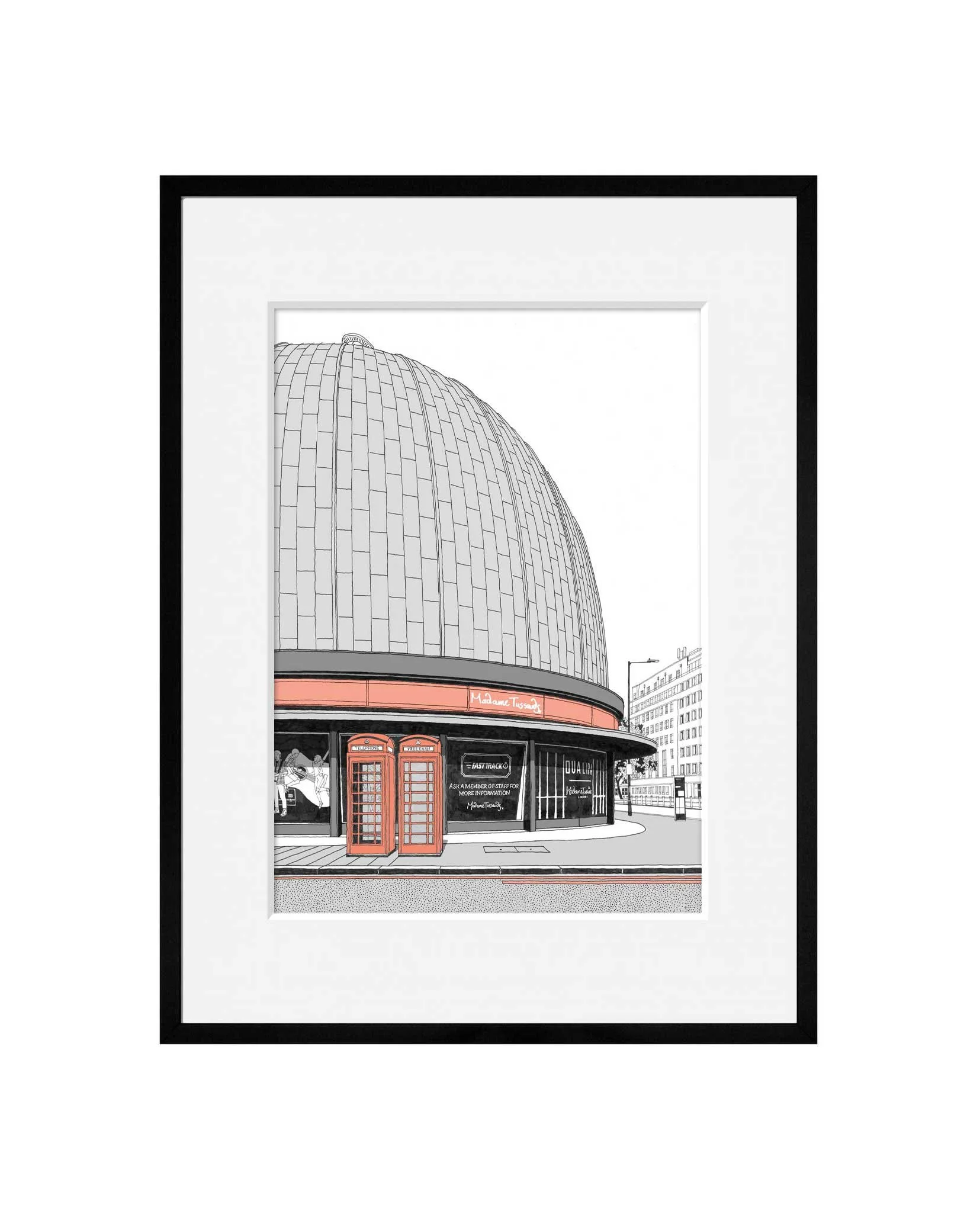
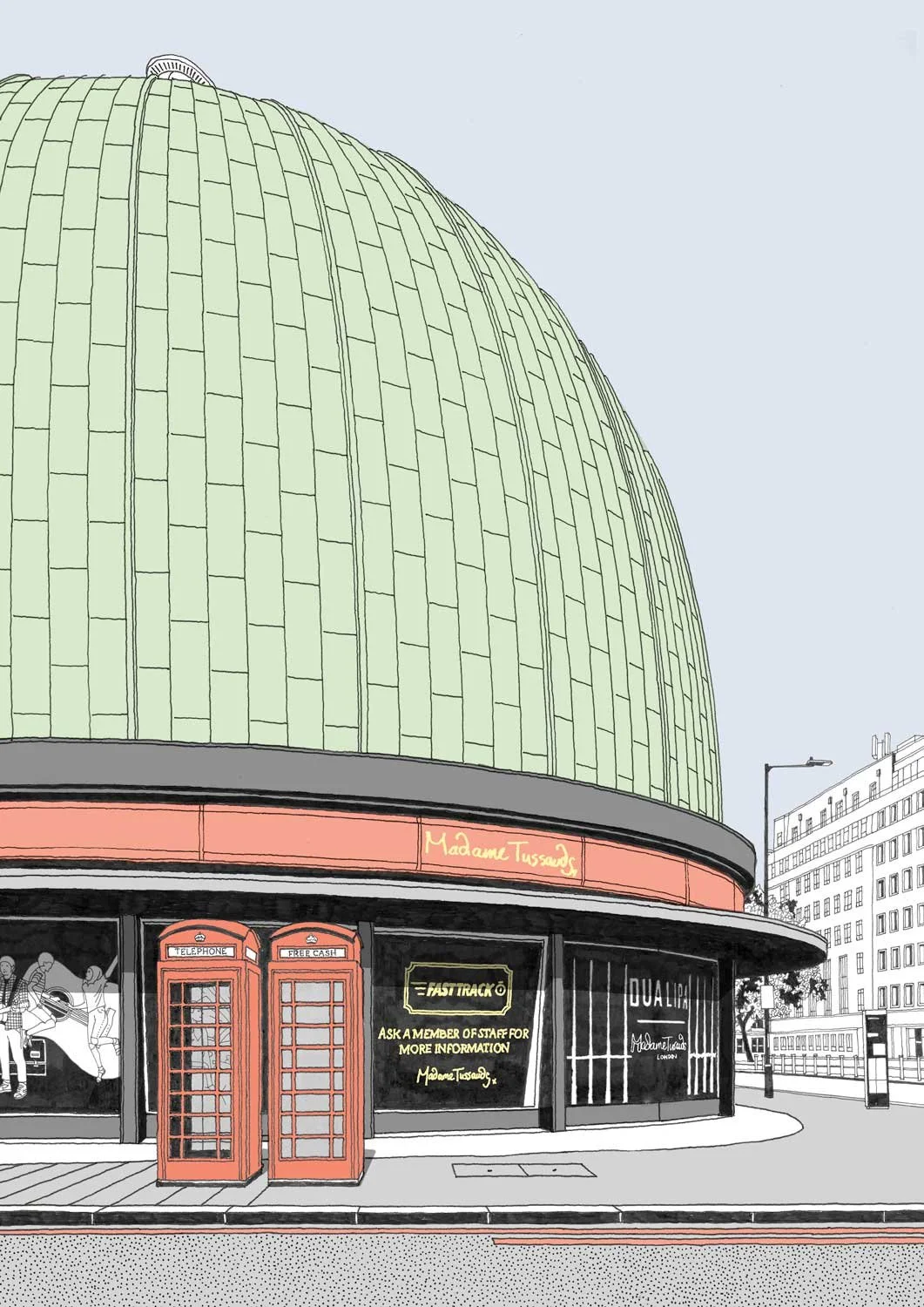
The London Planetarium & K6 Kiosks, Marylebone Road, London NW1

from £65.00
Size:

Illustration by Andrew Cadey

Located on the site of a former cinema destroyed by bombing in World War II, this was the first large-scale planetarium in Britain, designed by architect George Watt with the engineers Travers Morgan & Partners.

An archetypal 1950’s architecture; futuristic and optimistic for the ‘space age’, it took the form of a tall pre-cast concrete dome clad in copper, resting upon a circular concrete slab approximately 25 metres in diameter; this in turn was carried on a ring of twelve columns, set well back around the circumference of the slab to create a deep canopy.

The planetarium was opened to the public in 1958 and closed in 2006. The building has now been incorporated into the adjoining Madame Tussaud's Wax Museum.

The K6 (short for Kiosk No. 6) was designed in 1935 by architect Sir Giles Gilbert Scott.

It was a more refined version of an earlier K2 kiosk also designed by Scott in 1924, in which the K6 was simplified and streamlined. The windows give a more horizontal appearance in keeping with the “moderne’ aesthetics of the 1930s.

Undoubtedly a British icon.

Limited first edition print run of 20

Illustration by Andrew Cadey

Located on the site of a former cinema destroyed by bombing in World War II, this was the first large-scale planetarium in Britain, designed by architect George Watt with the engineers Travers Morgan & Partners.

An archetypal 1950’s architecture; futuristic and optimistic for the ‘space age’, it took the form of a tall pre-cast concrete dome clad in copper, resting upon a circular concrete slab approximately 25 metres in diameter; this in turn was carried on a ring of twelve columns, set well back around the circumference of the slab to create a deep canopy.

The planetarium was opened to the public in 1958 and closed in 2006. The building has now been incorporated into the adjoining Madame Tussaud's Wax Museum.

The K6 (short for Kiosk No. 6) was designed in 1935 by architect Sir Giles Gilbert Scott.

It was a more refined version of an earlier K2 kiosk also designed by Scott in 1924, in which the K6 was simplified and streamlined. The windows give a more horizontal appearance in keeping with the “moderne’ aesthetics of the 1930s.

Undoubtedly a British icon.

Limited first edition print run of 20

Product Details

Print: Printed on 240gsm Alpha Cellulose paper with a clean white base and a smooth matt surface and acid free. (Titled, signed and numbered in pencil on the reverse)

Mount: High quality ‘ice white’ picture mount with precision cut bevelled edge and a card backing board with printed label. All card is acid free, conservation quality white core, ph neutral board 1.4mm thick